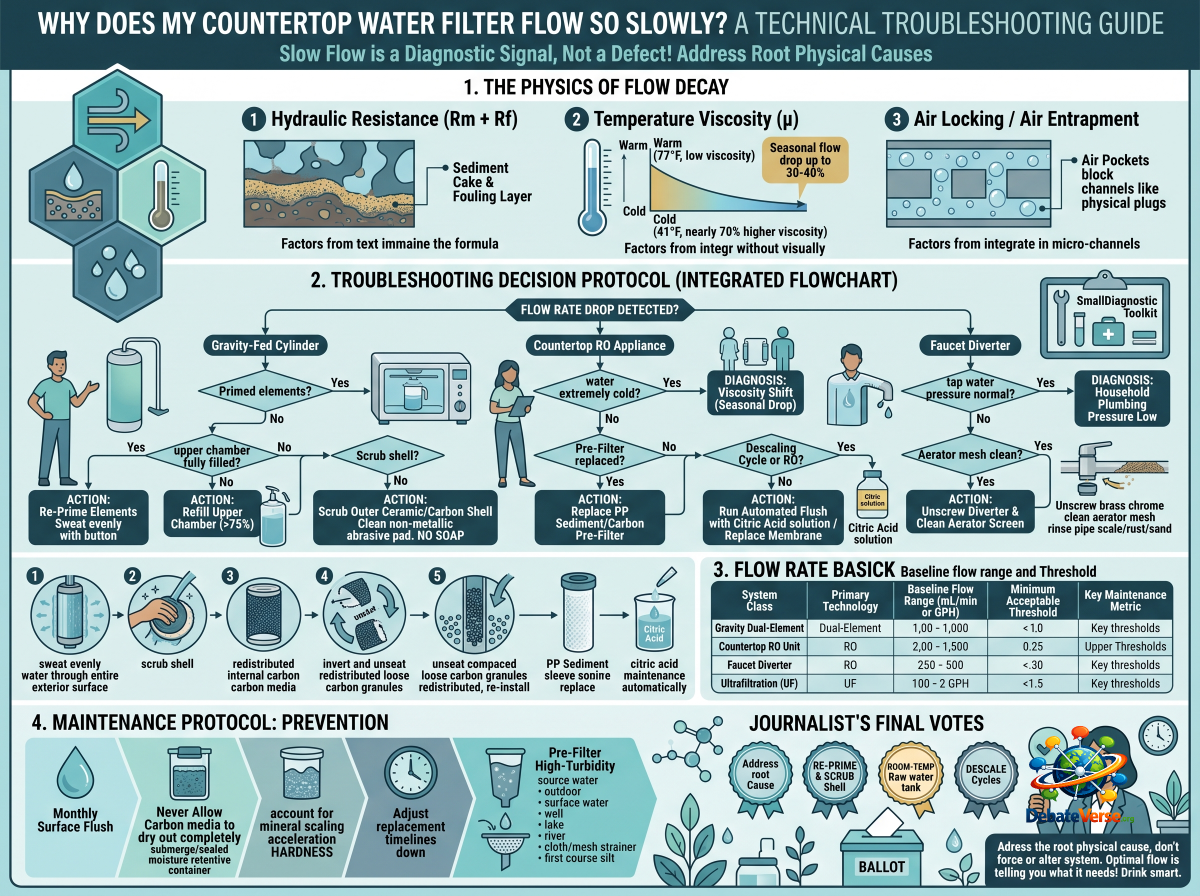
A sudden or gradual drop in water filter flow rate is the single most common complaint among owners of countertop filtration systems. Whether you rely on a gravity-fed stainless steel cylinder, a direct faucet diverter, or a high-tech countertop Reverse Osmosis (RO) appliance, a trickling stream can turn simple daily hydration into a frustrating bottle-neck.
In fluid mechanics, a slowing flow rate is rarely a mechanical defect. Instead, it is an active diagnostic signal. Water filters operate by balancing hydraulic conductivity against contaminant exclusion. When water flow slows down, the filter media is responding to physical, chemical, or thermodynamic forces inside the filter cartridge.
This guide breaks down the physics of flow decay, provides a diagnostic flowchart for all major countertop system types, and delivers actionable protocols to restore your water filter's flow rate.
=>Check out these Brand products on Amazon:
Waterdrop M6CG Hot & Cold Reverse Osmosis System Countertop, Mineral Added | Glass Pitcher, NSF/ANSI 58 Certified, 8-Stage RO Filtration, 3:1 Pure to Drain, Hot & Cold & Room-Temp Water, No Installation
Big Berkey Gravity-Fed Stainless Steel Countertop Water Filter System 2.25 Gallon with 2 Authentic Black Berkey Elements BB9-2 Filters
Aquasana Countertop Water Filter | Reduces Lead, PFAS & Microplastics | No Wastewater | Retains Beneficial Minerals | Filters One Glass in 8 Seconds | No Installation | 300-Gallon Filter
ZeroWater 10-Cup Ready-Pour 5-Stage Water Filter Pitcher 0 TDS for Improved Tap Water Taste - IAPMO Certified to Reduce Lead, Chromium, and PFOA/PFOS
LifeStraw Home — High-Capacity Water Filter Dispenser, 35-Cup, White, BPA-Free Designed for Everyday Protects Against Bacteria, Parasites, Microplastics, PFAS, Lead, and Improves Taste
1. The Physics of Flow Decay: Viscosity, Resistance, and Fouling
To troubleshoot a slow filter, you must understand the mathematical relationship governing fluid movement through micro-porous media.
plot
[ FLOW DECAY DRIVERS ]
 ├─ Hydraulic Resistance (Rm + Rf)  --> Sediment accumulation & pore occlusion
 ├─ Temperature Viscosity (μ)       --> Cold water increases fluid thickness/resistance
 └─ Vapor Lock / Air Entrapment     --> Trapped air bubbles block micro-channels
Darcy’s Law & Membrane Resistance
The volumetric flow rate (Q) through any microporous filter bed or synthetic membrane is defined by the modified Darcy's Law equation:
Q=μ⋅(Rm+Rf)ΔP⋅A
Where:
Q = Volumetric flow rate (mL/min or GPM)
ΔP = Transmembrane differential pressure (gravitational head pressure or booster pump pressure)
A = Active surface area of the filter media (cm2)
μ = Dynamic viscosity of water (mPa⋅s)
Rm = Intrinsic resistance of clean filter media (m−1)
Rf = Resistance of the fouling layer (m−1)
The Three Major Causes of Low Flow Rates:
#### 1. Fouling Resistance (Rf)
As raw feed water passes through activated carbon blocks or RO membranes, suspended particulates, ferric rust, and colloidal clays coat the outer surface, forming a dense "cake layer." This cake layer increases Rf, reducing Q even if the internal media remains clean.
#### 2. Water Temperature and Dynamic Viscosity (μ)
Water viscosity is inversely proportional to temperature. At 77∘F (25∘C), water has a dynamic viscosity of ≈0.89 mPa⋅s. At 41∘F (5∘C)—typical winter tap water temperatures—viscosity increases by nearly 70% to ≈1.52 mPa⋅s. Consequently, a system fed with ice-cold winter tap water can experience up to a 30%−40% flow drop without any physical clogging.
#### 3. Air Locking (Vapor Lock)
Because carbon blocks and ceramic candles consist of microscopic, tortuous channels, air displaced during filling can become trapped by capillary action. These air pockets act as physical plugs, drastically reducing the active surface area (A).
2. Troubleshooting Decision Protocol
Use this diagnostic flow diagram to isolate the exact cause of flow degradation across any countertop system:
3. System-Specific Root Causes & Actionable Fixes
Different countertop filtration form factors encounter distinct operational bottlenecks. Here is how to fix slow flow rate across the three core categories:
Category A: Gravity Systems (Berkey, British Berkefeld, Alexapure)
Gravity systems lack electrical pumps, making them especially sensitive to small changes in hydraulic head pressure and air lock.
Cause 1: Capillary Air Lock
Symptom: New or recently cleaned elements drip rapidly for a few minutes, then slow down to a crawl despite a full upper chamber.
Fix: Remove the elements and attach the soft rubber priming button to the threaded stem. Press firmly against your sink faucet and run cold water until water sweats evenly across the entire outer surface. This forces trapped air bubbles out through the pores.
Cause 2: Exterior Surface Bio-Fouling & Silt Cake
Symptom: Flow rate gradually drops over 2 to 3 months of continuous use.
Fix: Remove elements and scrub the exterior with a clean, non-metallic abrasive pad (like a Scotch-Brite pad reserved solely for water filters) under cold running water. Never use soap or detergent. Re-prime after scrubbing.
Cause 3: Insufficient Hydraulic Head (ΔP)
Symptom: The system filters quickly when completely full, but stops dripping when the top chamber drops below half.
Fix: Keep the upper chamber filled past 75% capacity. Gravitational force drops linearly as the water level lowers.
Category B: Countertop RO Appliances (Waterdrop, AquaTru, Rove)
Countertop Reverse Osmosis systems use high-pressure booster pumps to force water through polyamide membranes (0.0001 microns).
Cause 1: Clogged Polypropylene (PP) Sediment Pre-Filter
Symptom: The booster pump sounds higher-pitched or runs continuously without filling the pure water pitcher.
Fix: The pre-filter has shielded the expensive RO membrane by trapping heavy sediment. Replace the pre-filter cartridge immediately to restore inlet pressure to the pump.
Cause 2: Mineral Scaling on RO Membrane
Symptom: In hard water regions (TDS>300 PPM), pure water recovery slows dramatically over 6 to 12 months, accompanied by increased wastewater discharge.
Fix: Scale deposits (CaCO3) have locked the membrane pores. If your appliance offers an automated maintenance flush, run it using a food-grade citric acid descaling solution. If flow remains restricted, replace the RO TFC membrane module.
Cause 3: Low Feed Water Temperature
Symptom: The system runs noticeably slower during winter months.
Fix: This is a natural thermodynamic limitation. If using a reservoir-fed countertop RO unit, fill the raw water tank with room-temperature tap water rather than cold tap water to maintain optimal membrane permeability.
Category C: Direct Faucet Diverters & Pitchers
Cause 1: Debris Clogging the Diverter Aerator Screen
Symptom: Water trickles from the filter spout, but main sink tap pressure is completely normal.
Fix: Unscrew the brass or chrome diverter mechanism from the faucet tip. Remove the stainless steel inlet aerator screen and rinse away trapped pipe scale, rust flakes, and sand.
Cause 2: Carbon Fine Compaction
Symptom: A brand-new carbon block filter flows slowly right out of the box.
Fix: Transport and handling can compact loose carbon granules. Unseat the cartridge, invert it under tap water, tap the sides lightly against the sink wall to redistribute internal carbon media, and re-install.
4. Flow Rate Benchmark Table
To evaluate whether your countertop filter is operating within healthy performance specifications, compare your system's current output against industry baseline flow benchmarks:
| System Class |
Primary Technology |
Baseline Flow Rate Range |
Minimum Acceptable Threshold |
Key Maintenance Metric |
| Gravity Dual-Element |
Black Carbon / Ceramic |
0.25−0.50 GPH (1−2 L/hr) |
<0.10 GPH (0.4 L/hr) |
Scrub & Re-Prime required |
| Countertop RO Unit |
TFC Membrane + Pump |
0.03−0.08 GPM (100−300 mL/min) |
<0.015 GPM (60 mL/min) |
Check pre-filter / TDS |
| Faucet Diverter |
Carbon Block |
0.50−0.85 GPM (1.9−3.2 L/min) |
<0.25 GPM (0.9 L/min) |
Clean aerator screen |
| Ultrafiltration (UF) |
Hollow-Fiber Membrane |
0.30−0.60 GPM (1.1−2.2 L/min) |
<0.15 GPM (0.57 L/min) |
Backwash / Replace sleeve |
5. Maintenance Protocol to Prevent Flow Degradation
To maintain optimal flow rates without sacrificing contaminant rejection efficiency, follow these four preventative care practices:
1. Conduct a Monthly Surface Flush: For gravity and faucet systems, rinse and lightly wipe down filter exteriors monthly to remove surface biofilms before they turn into dense cake layers.
2. Never Allow Carbon Media to Dry Out Completely: If you leave home for more than a few days, leave your filter elements submerged or sealed in moisture-retentive containers. Completely dried-out carbon blocks develop severe air locks when re-hydrated.
3. Monitor Water Hardness: If your tap water hardness exceeds 180 PPM (10 grains per gallon), adjust filter replacement timelines down by 20%−30% to account for mineral scaling acceleration.
4. Pre-Filter High-Turbidity Source Water: If using gravity filters on un-treated outdoor surface water (well, lake, river), always pre-filter raw water through a clean cloth or micro-mesh strainer to trap coarse silt before it hits your core elements.
The Journalist’s Final Verdict
A slowing countertop water filter is not broken—it is telling you what it needs.
For Gravity Filter Owners: 90% of slow-flow issues are caused by capillary air locks or fine surface silt buildup. Re-priming the elements and scrubbing the outer shell with a fresh pad will almost always restore output.
For Countertop RO Owners: Seasonal temperature drops and clogged pre-filters are the primary culprits. Keep your raw feed water at room temperature, replace sediment pre-filters on schedule, and run descaling cycles if you live in a hard-water region.
The Takeaway: Never attempt to force water through a clogged system by applying excessive pressure or altering filter housing seals. Addressing the root physical cause restores optimal flow rate while keeping your drinking water safe and pure.
Main References:
1. American Water Works Association (AWWA). (2020). Water Treatment Plant Design: Membrane Filtration Processes and Operations. McGraw-Hill Education, 5th Ed.
2. NSF International. (2023). NSF/ANSI Standard 53: Drinking Water Treatment Units - Health Effects. Ann Arbor, MI: NSF International.
3. Water Quality Association (WQA). (2022). Diagnosing Flow Decay and Fouling Mechanics in Point-of-Use Water Treatment Systems. WQA Technical Series.
4. U.S. Environmental Protection Agency (EPA). (2021). Small System Compliance Technology List for Microfiltration and Reverse Osmosis Membranes. EPA 815-R-21-002.