Walk down the water aisle or scroll through online filtration listings, and you will be inundated with impressive-sounding claims: "Reduces up to 99% of harmful chemicals!", "Laboratory tested for maximum purity!", or "Built to rigid safety standards!"
In the water treatment industry, talk is cheap—and marketing copy is cheaper.
The only true line of defense between consumers and deceptive product claims is independent third-party certification. At the top of this hierarchy stands NSF International (formerly the National Sanitation Foundation) and its ANSI-accredited partner organizations (such as the Water Quality Association, or WQA).
However, seeing an "NSF" logo on a box does not mean a system removes every dangerous chemical from your tap. A filter can be certified by NSF to make your water taste better while leaving toxic lead and "forever chemicals" untouched.
To make an educated purchase, you must decode the four critical American National Standards Institute (ANSI) standards governing countertop and residential water treatment.
=>Check out these Brand products on Amazon:
Waterdrop M6CG Hot & Cold Reverse Osmosis System Countertop, Mineral Added | Glass Pitcher, NSF/ANSI 58 Certified, 8-Stage RO Filtration, 3:1 Pure to Drain, Hot & Cold & Room-Temp Water, No Installation
Big Berkey Gravity-Fed Stainless Steel Countertop Water Filter System 2.25 Gallon with 2 Authentic Black Berkey Elements BB9-2 Filters
Aquasana Countertop Water Filter | Reduces Lead, PFAS & Microplastics | No Wastewater | Retains Beneficial Minerals | Filters One Glass in 8 Seconds | No Installation | 300-Gallon Filter
ZeroWater 10-Cup Ready-Pour 5-Stage Water Filter Pitcher 0 TDS for Improved Tap Water Taste - IAPMO Certified to Reduce Lead, Chromium, and PFOA/PFOS
LifeStraw Home — High-Capacity Water Filter Dispenser, 35-Cup, White, BPA-Free Designed for Everyday Protects Against Bacteria, Parasites, Microplastics, PFAS, Lead, and Improves Taste
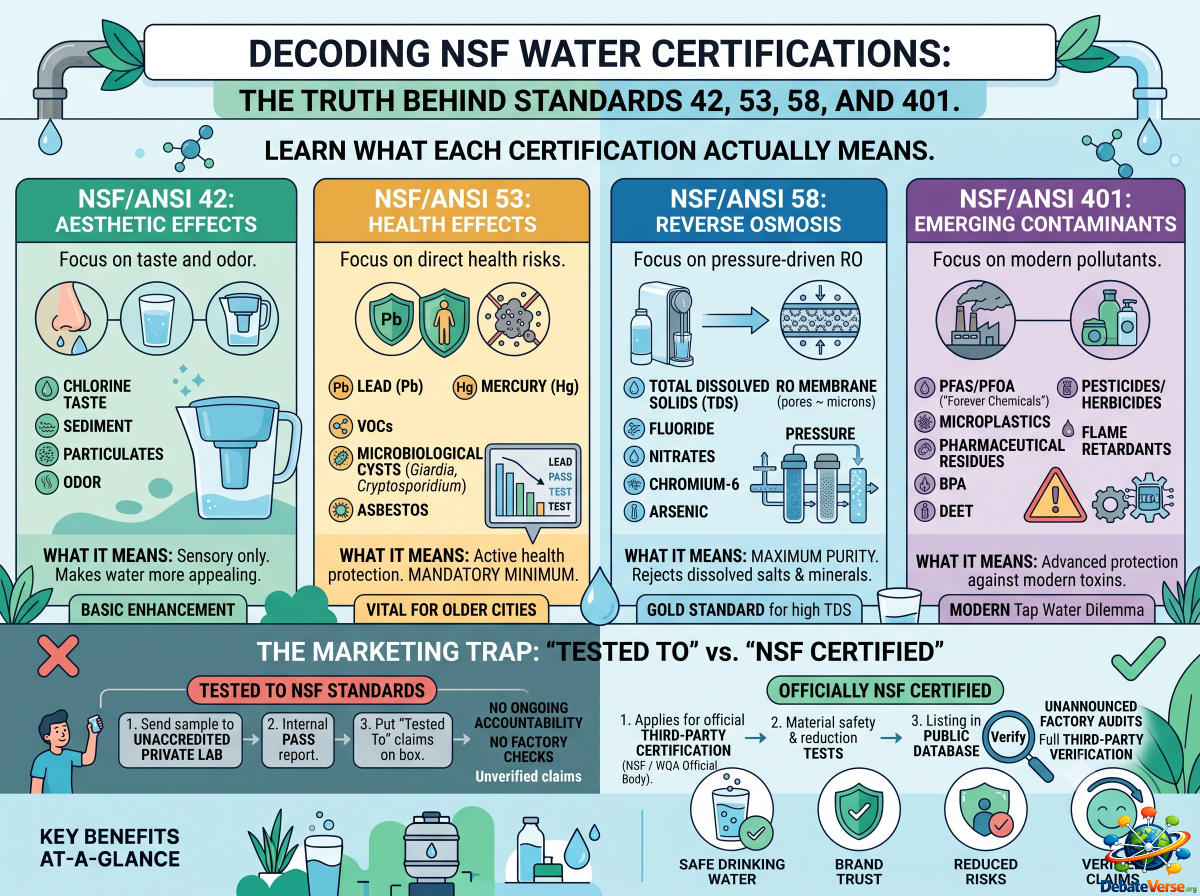
1. The Big Four NSF/ANSI Standards Demystified
NSF/ANSI Standard 42: Aesthetic Effects
Standard 42 is the most common—and basic—certification in the water industry. It measures a system’s ability to improve the sensory qualities of drinking water.
Primary Targets: Chlorine taste and odor, chloramines, and nominal particulate matter (rust, dirt, sediment).
What it Means for Health: Virtually nothing. While drinking chlorine-tasting water is unappealing, chlorine at municipal levels is a sanitizer, not an immediate health toxin.
The Takeaway: A system certified only to Standard 42 is essentially an aesthetic enhancement tool, typical of basic, low-cost pitcher filters.
NSF/ANSI Standard 53: Health Effects
Standard 53 marks the line where filtration transitions from cosmetic taste improvements to verifiable health protection.
Primary Targets: Contaminants with documented adverse health effects, including heavy metals like lead Pb2+ and mercury Hg2+, volatile organic compounds (VOCs), asbestos, MTBE (gasoline additives), chlordane, and microbiological cysts like Giardia and Cryptosporidium.
Testing Rigor: To pass, a filter must reduce lead from an influent challenge concentration of 0.15 mg/L down to below the action limit of 0.005 mg/L (5 parts per billion) throughout its claimed service life.
The Takeaway: If your home relies on aging lead infrastructure or municipal tap water prone to industrial runoff, NSF 53 is an absolute mandatory minimum.
NSF/ANSI Standard 58: Reverse Osmosis Systems
Standard 58 is designed explicitly for pressure-driven Reverse Osmosis (RO) systems. Because RO membranes filter at sub-nanometer levels (≈0.0001 microns), standard flow-through carbon testing does not apply.
Primary Targets: Total Dissolved Solids (TDS), fluoride, hexavalent chromium Cr(VI), nitrate/nitrite, radium 226/228, and inorganic arsenic As(V).
Efficiency Requirements: Standard 58 also measures structural integrity, safety of water-contact materials, and system recovery efficiency (measuring how much purified water is produced relative to wastewater generated).
The Takeaway: Standard 58 is the gold standard for countertop RO appliances (like Waterdrop), ensuring the membrane actively strips inorganic salts and toxic minerals that carbon block media miss.
NSF/ANSI Standard 401: Emerging Compounds & Incidental Contaminants
Standard 401 was created to address modern pollutants that have entered public water systems through agricultural runoff, industrial waste, and consumer waste streams.
Primary Targets: 15 specific emerging contaminants categorized into pharmaceuticals (e.g., ibuprofen, naproxen, atenolol), pesticides/herbicides (e.g., linuron, DEET), flame retardants, bisphenol A (BPA), microplastics, and perfluorinated compounds (PFAS/PFOA/PFOS).
Why It Matters: While these trace chemicals exist at low concentration levels (nanograms to micrograms per liter), long-term exposure to endocrine disruptors poses emerging health concerns.
The Takeaway: Look for Standard 401 if you live near intensive agricultural zones, urban manufacturing hubs, or areas with known PFAS contamination.
2. Certification Breakdown Matrix
| Standard |
Primary Focus |
Key Contaminants Tested |
Typical Technology |
Essential For |
| NSF/ANSI 42 |
Aesthetics / Taste |
Chlorine, Nominal Particulates, Odor |
Granular Activated Carbon (GAC) |
Basic municipal tap enhancement |
| NSF/ANSI 53 |
Direct Health Risks |
Lead, Mercury, VOCs, Cysts, Asbestos |
Dense Carbon Block, Ion Exchange |
Older cities, lead pipe networks |
| NSF/ANSI 58 |
Reverse Osmosis |
TDS, Fluoride, Chromium-6, Nitrates |
Semi-Permeable RO Membrane |
High-TDS water, fluoride removal |
| NSF/ANSI 401 |
Emerging Toxins |
PFAS, Microplastics, Prescription Drugs |
Advanced Multi-Stage Carbon / RO |
Modern industrial/agricultural tap |
3. The Marketing Trap: "Tested To" vs. "NSF Certified"
As a consumer, the single biggest pitfall to avoid is clever linguistic misdirection on product packaging:
> "Tested to NSF Standards" = "NSF Certified"
"Tested according to NSF protocols": This means the manufacturer paid a private, unaccredited internal laboratory to test a single prototype once under controlled conditions. There is no ongoing quality assurance, no material extraction testing, and no regulatory oversight.
"NSF Certified": The manufacturer submitted the system to NSF International, WQA, or IAPMO. The certifying body verified that:
1. The filter reduces claimed contaminants for its entire rated lifespan.
2. The unit is structurally sound under water pressure spikes (no burst risk).
3. No harmful chemicals or heavy metals leach from the filter plastics into your water.
4. Manufacturing facilities are subject to unannounced annual audits.
4. How to Verify Any Filter in 60 Seconds
Never take a manufacturer’s word at face value. Before buying a countertop filtration system, verify its certification status directly with official databases:
1. Locate the exact manufacturer name and model number on the product listing.
2. Visit the official online listings:
NSF International Database: `nsf.org/certified-products-systems`
WQA Gold Seal Directory: `wqa.org/find-products`
IAPMO Listing Directory: `pld.iapmo.org`
3. Search for the brand name. If the product is officially certified, the exact model number will appear alongside a explicit list of contaminants it is verified to remove. If it does not appear, the "certification" claims are unverified marketing claims.