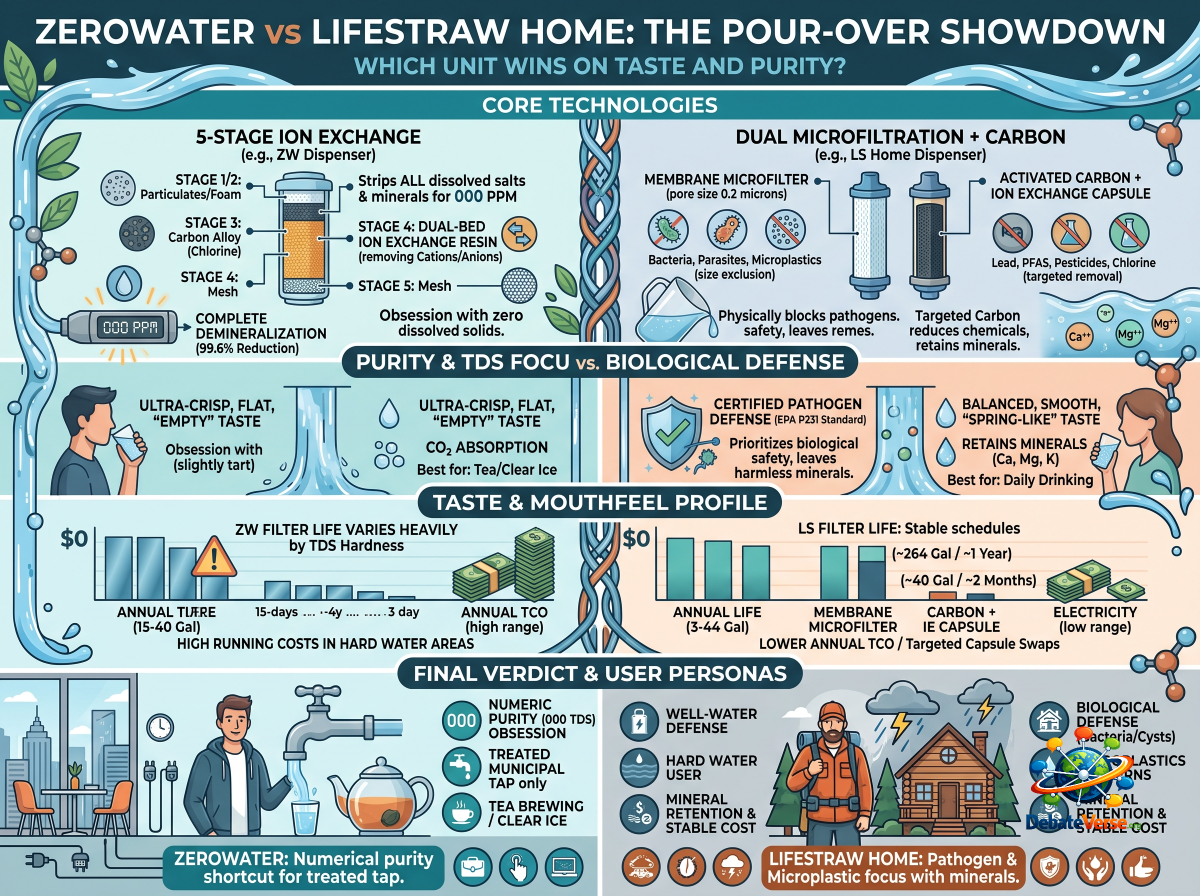
When it comes to pour-over countertop dispensers and high-capacity pitchers, two brands dominate consumer conversations for shoppers who want non-invasive, zero-plumbing filtration: ZeroWater and LifeStraw Home.
At first glance, both promise a massive step up from basic grocery store pitchers. However, beneath their glass and plastic housings lie radically different filtration philosophies.
ZeroWater aims for absolute numeric reduction, utilizing an aggressive 5-stage ion-exchange process engineered to bring your Total Dissolved Solids (TDS) meter down to a flawless `000 PPM`. LifeStraw Home, born from humanitarian water purification technology, prioritizes biological defense and targeted chemical reduction—using a sub-micron membrane to block pathogens, microplastics, and heavy metals while leaving essential minerals intact.
If you are trying to decide which system deserves a place on your kitchen counter, this journalistic teardown evaluates how both handle contaminant removal, taste profiles, daily speed, and long-term filter economics.
=>Check out these Brand products on Amazon:
1. Core Filtration Technologies: Deionization vs. Microfiltration
The fundamental split between ZeroWater and LifeStraw Home comes down to their physical and chemical mechanics.
ZeroWater: The 5-Stage Ion Exchange Engine
ZeroWater operates using a multi-layer cartridge designed to strip everything dissolved in your water:
LifeStraw Home: Membrane Microfiltration + Carbon Capsule
LifeStraw built its reputation developing filters for disaster zones and developing nations. The LifeStraw Home adapts that lab-grade technology for kitchen counters:
2. Purity & Contaminant Rejection: TDS vs. Biological Hazards
Evaluating "purity" depends entirely on what contaminants pose a threat to your specific water source.
Contaminant Removal Comparison
3. The Taste Profile & Mouthfeel Test
Water flavor is deeply subjective, but the chemical profiles of these two systems produce distinct, polar-opposite sensory experiences:
> ZeroWater Profile: Ultra-Crisp, Flat, and "Empty"
> Because ZeroWater strips all dissolved minerals, the resulting water has zero mineral body. To drinkers accustomed to high-TDS tap water, it tastes ultra-clean, crisp, and slightly acidic. If left sitting in an open dispenser, deionized water naturally absorbs carbon dioxide from the air, forming weak carbonic acid which can give it a slightly tart edge.
> LifeStraw Home Profile: Balanced, Natural, and Refreshing
> LifeStraw Home removes harsh chemical tastes like chlorine, chloramines, and metallic lead while allowing beneficial calcium, magnesium, and potassium ions to pass through. The result is a smooth, balanced taste that mimics high-end natural spring water.
4. Flow Yield, Capacity, and Total Cost of Ownership (TCO)
While initial purchase prices for both dispensers are comparable (60 for pitcher/dispenser formats), their long-term operating costs diverge significantly depending on your tap water hardness.
| Metric | ZeroWater (Dispenser / Pitcher) | LifeStraw Home (Dispenser / Pitcher) |
|---|---|---|
| Primary Mechanism | 5-Stage Ion Exchange | Membrane Microfilter + Carbon Capsule |
| Pore / Filter Metric | Complete Ionic Stripping | Physical Membrane |
| Target TDS Result | `000 PPM` | Retains Tap Baseline Minerals |
| Filter Lifespan (Primary) | 15 - 40 Gallons (TDS dependent) | Membrane: 264 Gallons (~1 Year) Carbon Filter: 40 Gallons (~2 Months) |
| Flow Speed | Moderate (~2-4 mins per pitcher) | Slow-to-Moderate (Membrane drip) |
| Microbiological Protection | Municipal Water Focus | EPA Purifier Standard (Bacteria/Cysts) |
| Annual Maintenance Cost | $80 - $180+ (Varies heavily by TDS) | $60 - $80 (Fixed cartridge schedule) |
The "Hard Water" Cost Trap
ZeroWater’s greatest strength is also its economic vulnerability. If your tap water has a high initial TDS reading (`300+ PPM`), the ion-exchange resin exhausts itself rapidly attempting to capture every harmless calcium ion. In hard water areas, a single ZeroWater filter may only last 15 to 20 gallons before water takes on a sour taste, driving annual filter costs up significantly.
LifeStraw Home’s membrane microfilter does not exhaust based on mineral content. The physical membrane lasts for 264 gallons (roughly a full year of daily use), while only the smaller $10 carbon/ion exchange capsule needs swapping every 40 gallons.
5. Decision Framework: Which System Fits Your Tap?
Use this decision matrix to determine which pour-over countertop system best serves your household:
The Verdict
Both units represent top-tier engineering in the non-plumbed, pour-over countertop category, but they serve two very different users: