If you have ever bought a pitch-style water filter or a countertop purifier, chances are a small blue digital device came in the box: a Total Dissolved Solids (TDS) meter.
Dip it into raw tap water, and the screen might read `240 PPM`. Dip it into a glass from a 5-stage ion-exchange pitcher, and it flashes a victorious `000 PPM`. The psychological impact is immediate: Zero must mean pure, and high numbers must mean dangerous, right?
Not necessarily.
In the world of water treatment, relying on a TDS meter as your sole indicator of water safety is one of the most widespread consumer misconceptions. A low TDS reading does not guarantee clean water, nor does a higher reading prove your filter isn't working.
Here is an investigative look at what TDS actually measures, what it dangerously ignores, and why "0 TDS" is often more about marketing than genuine health protection.
=>Check out these Brand products on Amazon:
1. What TDS Actually Measures (And What It Misses)
A hand-held TDS meter does not actually count dissolved particles directly. Instead, it measures electrical conductivity (EC).
Because pure water is a poor conductor of electricity, the presence of charged mineral ions—like sodium , calcium , magnesium , and chloride —allows an electrical current to pass between the meter’s two probes. The device then estimates the concentration in parts per million (PPM) or milligrams per liter () using a standard conversion formula:
Where is a conversion factor (typically between $0.55$ and $0.80$) based on sodium chloride calibration.
The Invisible Threats (What TDS Ignores)
Because TDS meters rely strictly on electrical conductivity, any uncharged or non-ionic contaminant slips past undetected:
2. The "Good TDS" vs. "Bad TDS" Paradox
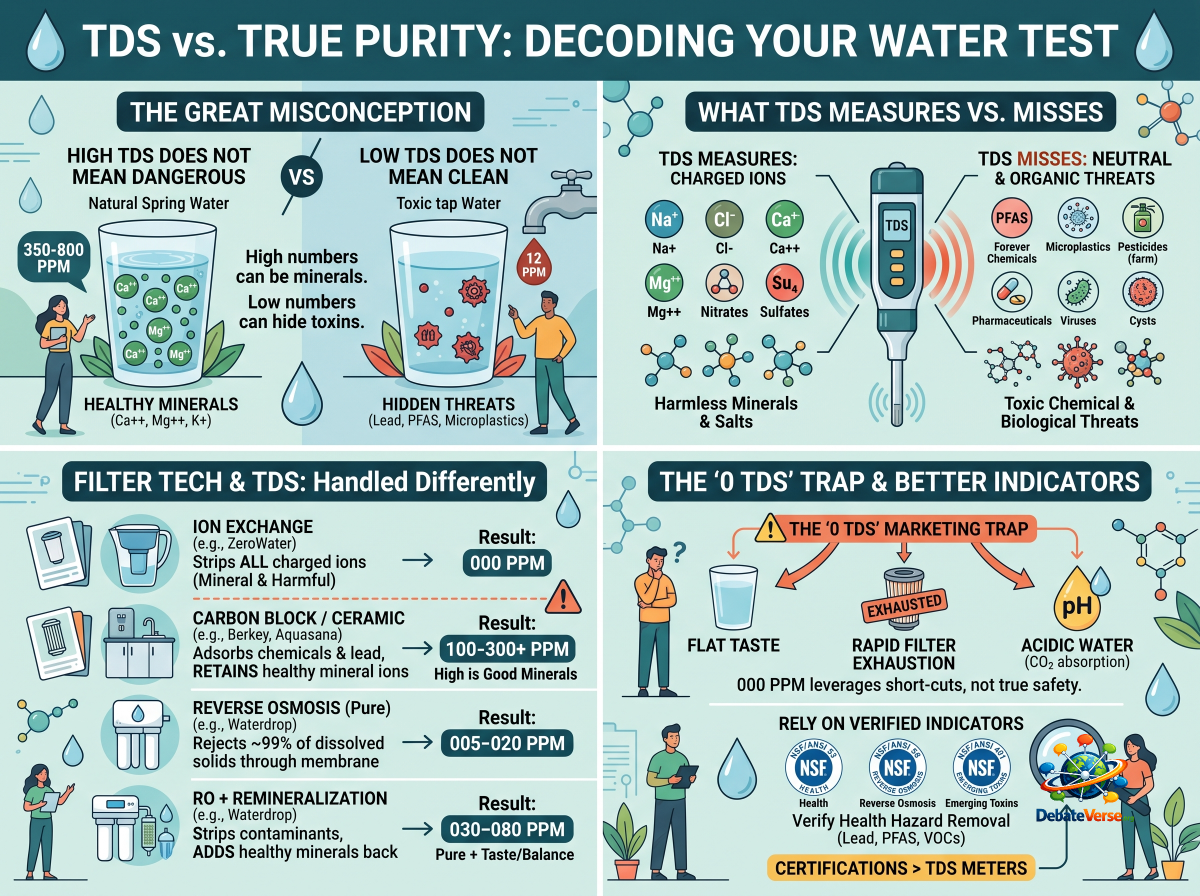
To understand why a raw TDS number is misleading, consider the comparison between natural mineral spring water and contaminated tap water.
[ Natural Spring Water ]                [ Dangerous Tap Water ]
   TDS: 350 - 800 PPM                      TDS: 12 PPM
   • Calcium (Ca²⁺)                        • Lead (Pb²⁺) [50 ppb]
   • Magnesium (Mg²⁺)                      • PFAS / PFOA
   • Potassium (K⁺)                        • Microplastics
   • Bicarbonates                          • Dissolved Gasoline (MTBE)
         │                                       │
         ▼                                       ▼
  ✅ HEALTHY & SAFE                       ❌ TOXIC & HAZARDOUS
The Scale Disparity: PPM vs. PPB
TDS meters measure in parts per million (). However, many severe toxins cause organ damage at concentrations measured in parts per billion:
If tap water contains of lead—ten times above the EPA action threshold—that lead contributes only $0.05$ to the TDS readout. A consumer seeing a TDS reading drop from `200` to `005` might assume their water is pure, even if that remaining `005` includes lethal heavy metal or chemical concentrations.
Conversely, premium bottled mineral waters (such as Evian or San Pellegrino) routinely register TDS levels between `300 PPM` and `850 PPM`. This high score is not pollution—it is healthy, bioavailable calcium carbonate and magnesium sulphate .
3. How Filter Technologies Handle TDS Differently
Understanding how different countertop filters handle TDS helps set realistic expectations for your water test results:
| Filtration Technology | Example Brand | Typical Post-Filter TDS | Why the Reading Is What It Is |
|---|---|---|---|
| 5-Stage Ion Exchange | ZeroWater | `000 PPM` | Uses mixed-bed deionization resins to strip all charged mineral ions alongside heavy metals. |
| Activated Carbon Block / Ceramics | Berkey, Aquasana | `100 - 300+ PPM` | Adsorbs organic chemicals, lead, and chlorine, but intentionally allows healthy mineral ions to pass through. |
| Reverse Osmosis (Pure RO) | Waterdrop (Base RO) | `005 - 020 PPM` | Rejects of all dissolved solids through a sub-nanometer membrane. |
| RO + Remineralization | Waterdrop (With Mineral Stage) | `030 - 080 PPM` | Strips contaminants first, then intentionally adds back calcium/magnesium for pH balance and taste. |
4. The 0 TDS Marketing Trap
Pitcher and countertop brands that emphasize "000 PPM" on their packaging are leveraging a visual shortcut. Stripping water down to zero TDS produces ultra-pure water, but it also alters the chemistry of the water:
1. Flat Taste Profile: Water devoid of natural minerals tastes aggressive, flat, or acidic.
2. Rapid Filter Exhaustion: In areas with hard water (`300+ PPM`), ion-exchange resins exhaust quickly because they must capture every harmless calcium ion alongside harmful lead ions.
3. pH Drop: Water with zero dissolved buffer ions absorbs carbon dioxide from the air, forming weak carbonic acid and lowering the pH to acidic levels ().
The Journalist’s Summary
When evaluating your home’s drinking water, remember these three rules: