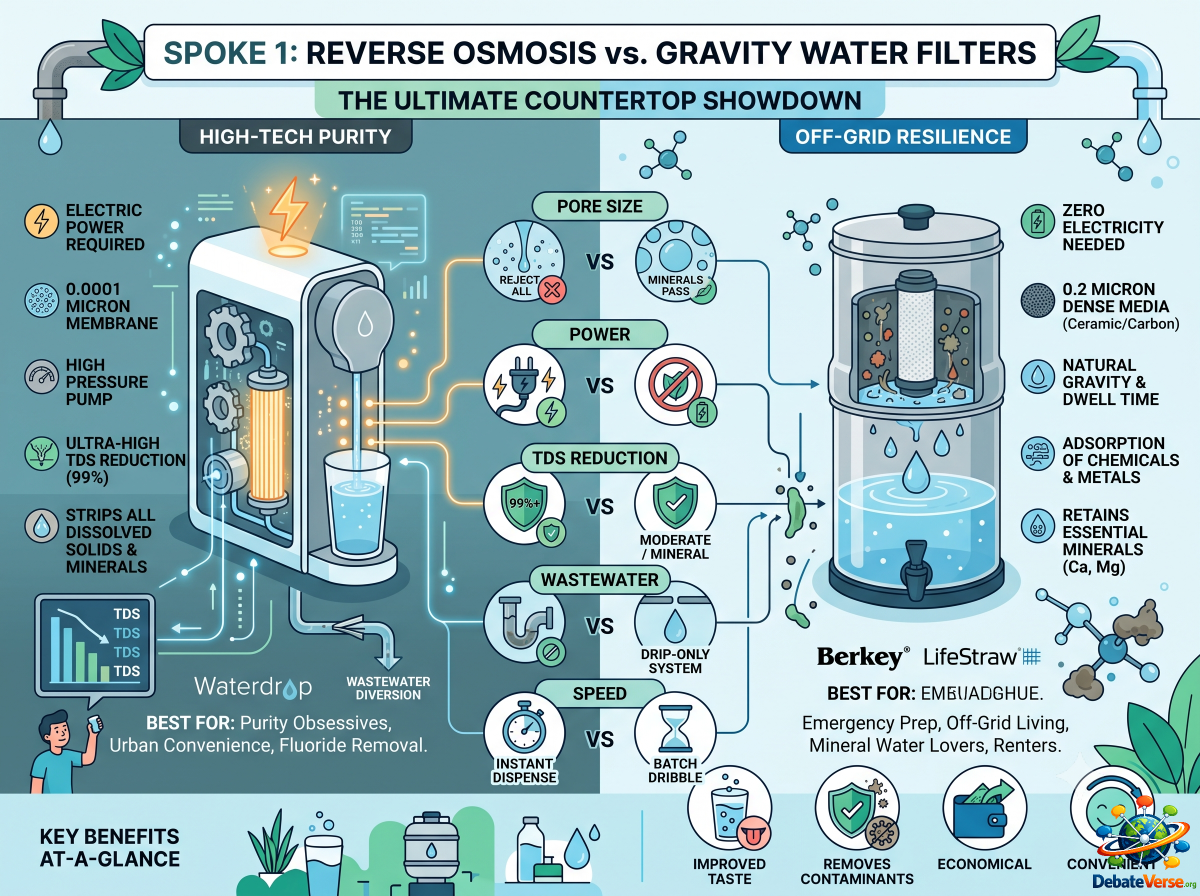
When you decide to reclaim your drinking water from municipal additives, aging lead pipes, or microplastic pollution, you will inevitably arrive at a fundamental crossroads: Reverse Osmosis (RO) or Gravity-Fed Filtration?
Both technologies dominate the countertop filtration landscape, but they represent two entirely different philosophies of water purification. One is a high-tech, pressure-driven appliance engineered for ultra-pure speed; the other is an off-grid, low-tech titan that relies on physics, dwell time, and zero electricity.
Here is an unvarnished journalist's breakdown of how these two filtration titans operate, where they excel, and which one belongs on your kitchen counter.
=>Check out these Brand products on Amazon:
Waterdrop M6CG Hot & Cold Reverse Osmosis System Countertop, Mineral Added | Glass Pitcher, NSF/ANSI 58 Certified, 8-Stage RO Filtration, 3:1 Pure to Drain, Hot & Cold & Room-Temp Water, No Installation
Big Berkey Gravity-Fed Stainless Steel Countertop Water Filter System 2.25 Gallon with 2 Authentic Black Berkey Elements BB9-2 Filters
Aquasana Countertop Water Filter | Reduces Lead, PFAS & Microplastics | No Wastewater | Retains Beneficial Minerals | Filters One Glass in 8 Seconds | No Installation | 300-Gallon Filter
ZeroWater 10-Cup Ready-Pour 5-Stage Water Filter Pitcher 0 TDS for Improved Tap Water Taste - IAPMO Certified to Reduce Lead, Chromium, and PFOA/PFOS
LifeStraw Home — High-Capacity Water Filter Dispenser, 35-Cup, White, BPA-Free Designed for Everyday Protects Against Bacteria, Parasites, Microplastics, PFAS, Lead, and Improves Taste
1. The Core Mechanisms: How They Work
To understand the difference in water quality, you first have to understand how water moves through each system.
Reverse Osmosis: High-Pressure Membrane Separation
Countertop RO systems use an internal electric pump to push raw tap water through a semi-permeable membrane with pore sizes measuring approximately 0.0001 microns. For scale, a single strand of human hair is roughly 70,000 nm wide, while an RO pore is roughly 0.1 nm.
Because the pores are so minuscule, the system must apply external pressure to overcome natural osmotic pressure. The contaminant rejection efficiency R is calculated by comparing raw feed concentration Craw to purified water concentration Cpurified:
R(%)=(1−CrawCpurified)×100
The Result: Virtually all Total Dissolved Solids (TDS), fluoride, heavy metals, arsenic, and microplastics are stripped away, leaving near-distilled baseline purity.
Gravity-Fed: Dwell Time & Adsorption
Gravity systems (such as stainless-steel units from Berkey or LifeStraw) do not use electricity, pumps, or tap pressure. You manually pour water into an upper chamber, and earth’s gravitational pull slowly draws the water down through dense carbon block or ceramic filter elements into a lower reservoir.
Pore Size: Typically ranges from 0.2 to 0.5 microns.
Secret Weapon: Dwell time. Because the water trickles through the dense media slowly, contaminants remain in contact with the active carbon matrix far longer than in pressurized systems, allowing deep chemical adsorption of chlorine, volatile organic compounds (VOCs), and heavy metals without stripping natural minerals.
2. Head-to-Head Vector Analysis
plot
              [ REVERSE OSMOSIS ]                     [ GRAVITY-FED ]

               High Pressure (Pump)                   Natural Gravity
                       │                                     │
                       ▼                                     ▼
             0.0001 Micron Membrane                    0.2 Micron Element
                       │                                     │
                       ▼                                     ▼
            Strips ALL Dissolved Solids              Retains Essential Minerals
                       │                                     │
                       ▼                                     ▼
             ⚡ Electric Power Needed                 🔋 Zero Power Needed
Flow Rate & Daily Yield
Reverse Osmosis: Winner for Speed. Powered countertop RO units dispense purified water on demand at rates of 1.0 to 1.5 liters per minute. You press a button, and your glass fills in seconds.
Gravity-Fed: Slower, Batch Process. Gravity filtration is measured in gallons per hour (GPH), not liters per minute. A typical two-element gravity system produces roughly 1.5 to 3.0 GPH. It requires forward planning: fill the top chamber in the morning to have water for the afternoon.
Wastewater & Environmental Impact
Reverse Osmosis: Traditional under-sink RO units send up to 4 gallons of waste water down the drain for every 1 gallon produced. Modern countertop RO units are far more efficient, utilizing internal loop pumps to achieve ratios between 1:1 and 3:1 (Pure-to-Waste). However, some wastewater generation is unavoidable.
Gravity-Fed: Zero Waste. Every drop of water poured into the top chamber ends up in the bottom tank.
Mineral Retention & Taste Profile
Reverse Osmosis: Strips beneficial minerals (calcium, magnesium) alongside harmful contaminants, resulting in a flat, ultra-crisp, "empty" taste profile. Many premium countertop RO units now include a post-filter remineralization stage to restore pH balance and subtle flavor.
Gravity-Fed: Leaves dissolved mineral salts intact while trapping heavy metals and synthetic chemicals. Water retains a natural, fresh spring-water mouthfeel.
Emergency Preparedness & Off-Grid Utility
Reverse Osmosis: Rendered completely useless during a power outage or off-grid scenario unless connected to a backup battery bank or generator.
Gravity-Fed: Unmatched Resilience. Operates anywhere, anytime. In a boil-water advisory or emergency, a quality gravity system can safely process untreated rainwater, river water, or pool water.
3. Side-by-Side Comparison Matrix
| Vector |
Countertop Reverse Osmosis (e.g., Waterdrop) |
Gravity-Fed Stainless (e.g., Berkey) |
| Pore Size |
≈0.0001 microns |
≈0.2 microns |
| Power Needed? |
Yes (110V Outlet required) |
No (100% Mechanical) |
| TDS Reduction |
Extreme (90%−99% reduction) |
Moderate (Leaves healthy minerals) |
| Wastewater Ratio |
1:1 to 3:1 pure-to-waste |
Zero Wastewater |
| Dispense Speed |
Instant (Glass filled in ~10 sec) |
Drip rate (Tank filled over hours) |
| Fluoride Removal |
Exceptional (Membrane level) |
Requires add-on secondary filters |
| Ideal User |
Urban renters, busy families, low TDS seekers |
Off-grid living, emergency preppers, mineral lovers |
4. Decision Flowchart: Which System Should You Buy?
Use this decision tree to determine which technology aligns with your household priorities:
The Journalist’s Verdict
There is no single "best" system—only the system that matches your specific living situation:
Select Countertop Reverse Osmosis if: You live in an apartment with good electrical outlet access, demand instant water delivery at the touch of a button, and want absolute peace of mind against dissolved salts, nitrates, PFAS, and heavy fluoride.
Select a Gravity-Fed System if: You prioritize energy independence, hate wasting a single drop of water, prefer the taste of natural mineral water, or want a bulletproof emergency safeguard for grid failures.