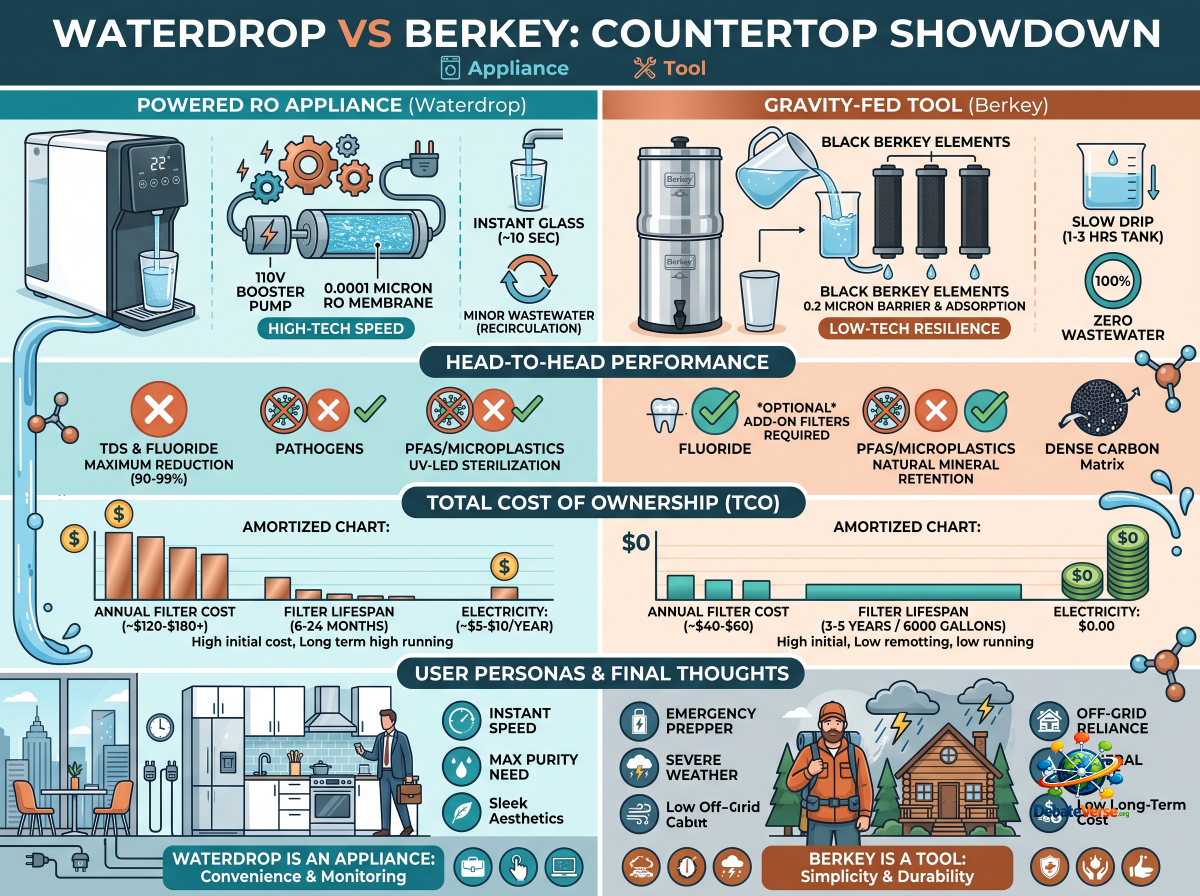
In the world of countertop water treatment, two giants dominate consumer shortlists, yet they represent diametrically opposed philosophies of engineering: The Waterdrop Countertop RO System and The Berkey Gravity-Fed Stainless Steel System.
On one side stands Waterdrop—a sleek, motorized appliance that uses high-pressure electric pumps to push water through sub-nanometer Reverse Osmosis (RO) membranes at the touch of a button. On the other stands Berkey—an iconic, non-electric stainless-steel cylinder that relies on earth's gravitational pull and dense carbon elements to purify water slowly over hours.
If you are trying to decide which system earns a permanent spot on your kitchen counter, this head-to-head comparison breaks down the mechanics, contaminant rejection performance, flow yields, and long-term operating costs of both systems.
=>Check out these Brand products on Amazon:
1. Technological Architecture: High-Tech Speed vs. Low-Tech Resilience
The fundamental difference between these two systems comes down to how water moves through the filtration media:
Waterdrop: Pressurized Membrane Filtration
Waterdrop relies on active mechanical work. An internal pump pressurized to over forces tap water through a multi-stage composite cartridge containing a semi-permeable membrane with pores measuring roughly .
Berkey: Passive Dwell Time & Adsorption
Berkey operates on passive fluid dynamics. Water poured into the upper chamber trickles through micro-porous Black Berkey elements via gravity. The filtration pores measure roughly , relying heavily on chemical adsorption and long contact time ("dwell time") rather than physical force.
2. Head-to-Head Performance Vectors
A. Contaminant Rejection Depth
B. Speed, Capacity, and Daily Friction
3. Total Cost of Ownership (TCO) Breakdown
While Berkey carries a higher initial price tag for its stainless steel housing, its filter elements carry a significantly longer rated lifespan compared to electronic RO cartridges.
| Cost Vector | Waterdrop Countertop RO (e.g., G1/A1 Series) | Berkey Stainless (e.g., Big Berkey) |
|---|---|---|
| Initial Hardware Cost | $300 - $600 | $350 - $450 |
| Filter Cartridge Lifespan | Pre-filter: 6 months RO Membrane: 12 - 24 months | Black Elements: 6,000 gallons per pair (approx. 3-5 years) |
| Annual Filter Cost | $120 - $180 / year | $40 - $60 / year (amortized) |
| Electricity Consumption | Minimal (~$5 - $10/year) | $0.00 |
| Wastewater Efficiency | 2:1 or 3:1 (Pure-to-Waste) | 100% Efficient (Zero waste) |
4. User Persona & Use-Case Matrix
Which system fits your living environment?
                       [ YOUR KITCHEN NEED ]
                                 │
         ┌───────────────────────┴───────────────────────┐
         ▼                                               ▼
(Urban Apartment / Modern Counter)           (Off-Grid / Cabin / Emergency)
   • Electric outlet nearby                     • Power outages common
   • Wants instant cup-filling                  • Prefers natural minerals
   • High TDS / Fluoride concerns               • Uses raw well or river water
         │                                               │
         ▼                                               ▼
 [ WATERDROP COUNTERTOP RO ]                   [ BERKEY GRAVITY SYSTEM ]
Choose Waterdrop If:
1. You want instant speed: You do not want to wait hours for water to drip into a lower chamber before making coffee or filling a water bottle.
2. You want a sleek, modern kitchen aesthetic: Waterdrop units fit under upper kitchen cabinets, featuring digital displays, real-time TDS monitoring, and electronic volume dispensing.
3. You live in a city with heavy fluoride or high TDS: You want the guaranteed sub-nanometer rejection of a powered RO membrane.
Choose Berkey If:
1. You want energy independence and off-grid resilience: You want a system that works during blackouts, severe storms, or off-grid living without needing batteries or electricity.
2. You want natural mineral retention: You prefer the fresh mouthfeel of natural spring water rather than pure, low-TDS "empty" water.
3. You hate paying for frequent replacement filters: Berkey elements last for thousands of gallons, drastically lowering long-term operating costs.
The Journalist's Final Verdict
The debate between Waterdrop and Berkey is not about which filter is "better"—it is about which engineering philosophy fits your routine: