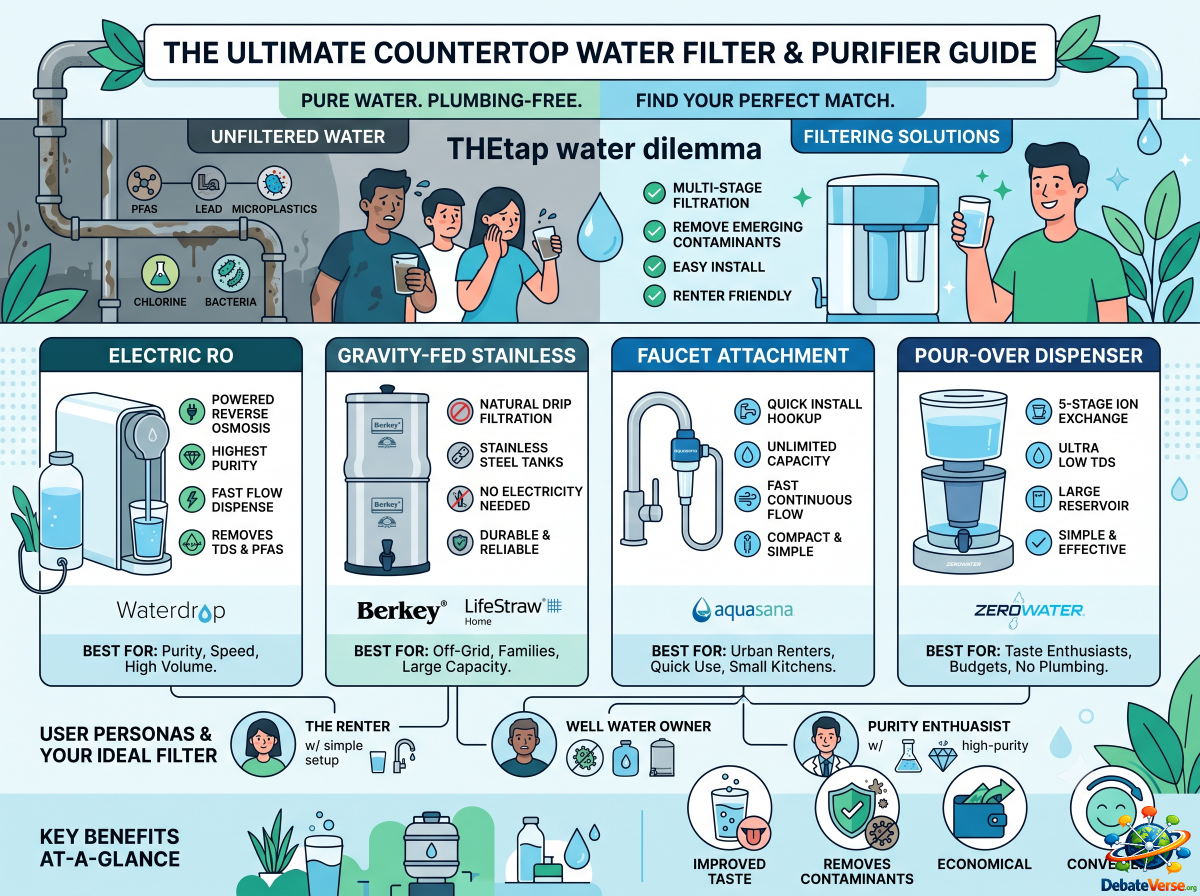
Turning on the tap in most modern households presents a quiet paradox: the water appears crystal clear, yet standard municipal testing often overlooks an invisible soup of emerging contaminants. From "forever chemicals" (PFAS) and microplastics to aging lead infrastructure and chloramines, the journey from treatment plant to kitchen glass is fraught with compromises.
For years, consumers were trapped between two extremes: cheap, low-capacity pitcher filters that remove little beyond chlorine taste, or invasive under-sink Reverse Osmosis (RO) installations requiring power drills, cabinet sacrifices, and plumber service calls.
Countertop water filtration and purification systems bridge this gap. They deliver commercial-grade purification, high daily flow yields, and modular maintenance without requiring a single hole in your kitchen counter or a modification to your lease agreement.
1. The Modern Tap Water Dilemma
While municipal water treatment facilities meet baseline federal health standards, "compliant" water does not equal pure water. Modern tap water carries legacy and emerging threats that standard carbon pitchers simply cannot manage:
       [ Municipal Water Plant ]
                  │
                  ▼ (Travels through aging pipes)
   [ Lead / Sediment / Microplastics ]
                  │
                  ▼
          [ Your Kitchen Tap ]
                  │
     ┌────────────┴────────────┐
     ▼                         ▼
(Standard Pitcher)   (Countertop Purifier)
 ❌ Slow flow         ✅ Multi-stage filtration
 ❌ High TDS remaining ✅ Removes PFAS, Lead, Microplastics
 ❌ Small capacity    ✅ Plug-and-play / Zero plumbing
2. The 3 Core Countertop Technologies Explained
Understanding how water moves through a system is crucial to choosing the right appliance for your kitchen setup. Countertop units fall into three distinct technological categories:
A. Electric Countertop Reverse Osmosis (RO)
Powered RO systems are the gold standard of mechanical purification. Using an internal electric pump, these units force pressurized tap water through a semi-permeable membrane with pore sizes down to approximately .
B. Gravity-Fed Stainless Steel Systems
Gravity-fed purifiers operate without electricity or municipal water pressure. Water poured into the top chamber trickles down through dense, highly porous ceramic or carbon block filter elements into a lower storage reservoir.
C. Pressurized Direct-Faucet Attachment Systems
These units sit directly on your counter and connect directly to your kitchen faucet aerator via a flexible hose and diverter valve. They utilize existing water pressure to push water through multi-stage inline filters.
3. Key Evaluation Criteria: The Buyer's Checklist
Before investing in a countertop filtration system, evaluate these four critical performance metrics:
1. Independent NSF/ANSI Certifications
Do not rely on manufacturer claims of "tested to NSF standards"—look for verified certifications from accredited testing bodies (NSF International, WQA, or IAMPO):
2. Efficiency & Wastewater Ratios
Traditional under-sink RO systems waste up to 4 to 5 gallons of water for every gallon of purified water produced. Modern countertop RO units utilize internal circulation pumps to drastically improve efficiency.
The recovery rate is calculated as:
Where represents the volume of pure water produced, and represents the total volume supplied. Modern countertop RO units routinely achieve ratios between () and ().
3. Total Cost of Ownership (TCO)
A low initial purchase price can be deceiving if replacement media must be swapped frequently. Calculate your annual running cost using this basic formula:
4. Category Leaders Compared
Here is how the top five industry-leading countertop systems stack up across key testing vectors:
| Brand & System | Technology | NSF Certifications | Flow Rate / Yield | Primary Use Case |
|---|---|---|---|---|
| Waterdrop | Electric Countertop RO | NSF/ANSI 58, 42, 53 | Instant (~1.5 L/min) | Renter-friendly high purity & fast dispense |
| Berkey | Gravity-Fed Stainless | Independent Lab (NSF Protocols) | ~1.5 - 3 GPH (Slow drip) | Off-grid, emergency preparedness, high volume |
| Aquasana | Faucet-Diverter Direct | NSF/ANSI 42, 53, 401 | 0.5 GPM (Continuous flow) | Urban renters wanting instant tap flow |
| ZeroWater | 5-Stage Ion-Exchange | NSF/ANSI 42, 53 | Pour-over speed | Ultra-low TDS on a budget |
| LifeStraw | Membrane Microfiltration | NSF/ANSI 42, 53, P231 | ~0.5 L/min | Well water / Pathogen & microbiological removal |
=>Check out these Brand products on Amazon:
5. System Decision Framework
Use the interactive flowchart below to determine which system configuration matches your living situation, water source, and performance priorities:
6. Installation & Maintenance Realities
Direct-Faucet Hookups
Connecting systems like the Aquasana Countertop takes less than five minutes:
1. Unscrew your existing kitchen faucet aerator.
2. Screw on the provided metal adapter ring.
3. Attach the dual-hose diverter valve mechanism.
4. Pull the diverter pin to route water through the filter; push it back to use normal tap water.
> Renter Note: Keep your original faucet aerator in a labeled bag inside your kitchen drawer. When your lease ends, simply unscrew the adapter and restore the original aerator—leaving zero trace of modification.
Standalone Reservoir Maintenance
For electric RO units like Waterdrop and gravity units like Berkey: