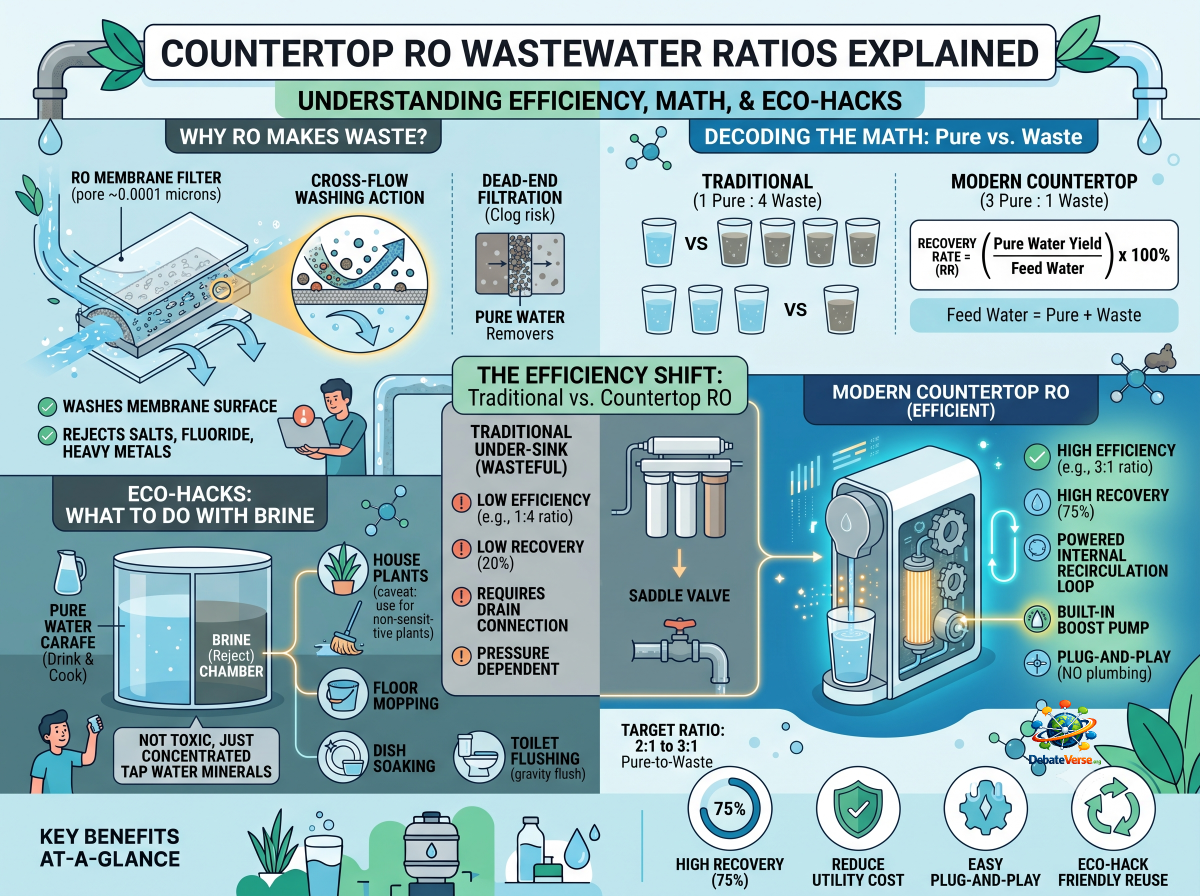
If you have ever researched Reverse Osmosis (RO) water purification, you have likely encountered an uncomfortable industry reality: to make pure water, RO systems must discard water.
For decades, traditional under-sink RO units earned a reputation as environmental squanderers, routinely sending 4 to 5 gallons of brine down the drain for every single gallon of drinkable water produced. However, the modern surge in electric countertop RO appliances has rewritten the rules of hydraulic efficiency.
Understanding how countertop RO wastewater ratios work—and how modern recirculating pumps cut waste by up to 80%—is critical to choosing an efficient system and keeping your utility bills in check.
=>Check out these Brand products on Amazon:
1. Why Reverse Osmosis Requires Wastewater
To understand why RO produces waste, you must look at how the membrane operates. Unlike standard carbon filters that act like a fine sieve (trapping dirt until the pores clog), an RO membrane operates on a principle called cross-flow filtration.
If water simply pushed straight through an RO membrane (dead-end filtration), the sub-nanometer pores would instantly become fouled by dissolved calcium, heavy metals, and organic matter.
To prevent this "scaling," the system sends a high-pressure stream across the surface of the membrane. This washing action splits the incoming feed water into two streams:
1. Permeate: Ultra-pure water forced through the microscopic membrane pores.
2. Reject (Brine): Concentrated wastewater carrying the rejected salts, fluoride, and heavy metals away from the membrane.
2. Calculating Efficiency: The Math Behind the Ratio
In product specifications, manufacturers express wastewater efficiency using either a Pure-to-Waste Ratio or a Recovery Rate Percentage. Because marketing teams often flip these numbers to sound more favorable, it helps to understand the underlying formulas.
The Pure-to-Waste Ratio
This expresses the volume of purified water produced relative to the volume of reject water discarded :
> Buyer Warning: Watch the order of the numbers! A traditional under-sink system with a Waste-to-Pure ratio of wastes 4 gallons to make 1. A high-efficiency countertop unit with a Pure-to-Waste ratio of yields 3 gallons of pure water per 1 gallon wasted. Always verify which number represents the pure yield.
The Recovery Rate Formula
The mathematical measurement of system efficiency is its Recovery Rate , calculated as:
Where the total feed water volume is:
3. How Countertop RO Beat Traditional Under-Sink Efficiency
Why do countertop RO systems achieve or pure-to-waste ratios while older under-sink models sit at a wasteful ? The secret lies in powered internal recirculation.
The Three Countertop Efficiency Upgrades:
1. Electric Booster Pumps: Standard home plumbing pressure fluctuates between , which is too low for high-yield RO. Countertop units use built-in electric booster pumps to push water across the membrane at optimal pressures exceeding .
2. Multi-Pass Recirculation: Instead of dumping reject water immediately down the sink drain, countertop units loop the brine back through the membrane multiple times to extract every possible drop of pure water.
3. Smart TDS Monitoring: Microprocessors monitor internal water conductivity. The system continues filtering until the reject stream reaches a maximum total dissolved solids threshold, dumping the concentrated waste only when necessary.
4. Comparing Wastewater Performance Across Technologies
| System Category | Typical Ratio (Pure : Waste) | Recovery Rate (%) | Requires Drain Connection? |
|---|---|---|---|
| Traditional Under-Sink RO | (1 Pure to 4 Waste) | Yes (Saddle valve on drain pipe) | |
| Standard Countertop RO | (1 Pure to 1 Waste) | No (Dual-chamber removable tank) | |
| High-Efficiency Countertop RO | (2-3 Pure to 1 Waste) | No (Internal recirculation loop) | |
| Gravity Stainless (Berkey) | (Zero Waste) | No (Gravity flow) |
5. What to Do with RO "Waste" Water (Eco-Hacks)
Because countertop RO systems do not connect to a drain line, wastewater collects in a separate chamber inside the raw water tank.
It is important to remember that this reject water is not toxic waste. It is simply concentrated municipal tap water containing the minerals, salts, and particulates rejected during purification.
                          [ Countertop RO Tank ]
                                     │
                 ┌───────────────────┴───────────────────┐
                 ▼                                       ▼
       (Pure Water Dispensed)                  (Reject Brine Tank)
                 │                                       │
          Drinking / Cooking             ┌───────────────┼───────────────┐
                                         ▼               ▼               ▼
                                   House Plants     Floor Mopping   Dish Soaking
Smart Ways to Re-Use Countertop RO Reject Water:
The Bottom Line
When shopping for a countertop Reverse Osmosis system, ignore vague claims like "eco-friendly" or "low waste." Look directly at the technical specification sheet for the Pure-to-Waste ratio:
A high-efficiency countertop RO unit gives you pure water without high utility bills—and the dual-tank design allows you to repurpose every remaining drop.