For homeowners and renters looking to upgrade their drinking water without committing to permanent under-sink plumbing, Aquasana occupies a distinct niche in the countertop filtration landscape.
While Reverse Osmosis (RO) systems rely on complete demineralization and gravity pitchers rely on slow trickle filtration, Aquasana’s lineup centers around its proprietary Claryum® selective filtration technology. Engineered to strip up to 99% of 77+ toxic contaminants while allowing beneficial minerals like calcium and magnesium to pass through, Aquasana offers a compelling compromise between high-level purity and mineral-rich taste.
This deep-dive review analyzes Aquasana’s primary countertop architectures—the direct-connect AQ-4000 Faucet System and the motorized Clean Water Machine (AQ-CWM2)—evaluating their four-stage mechanical engineering, NSF lab certifications, real-world flow rates, and long-term operating costs.
=>Check out these Brand products on Amazon:
1. The Claryum® Engine: Four-Stage Mechanical Architecture
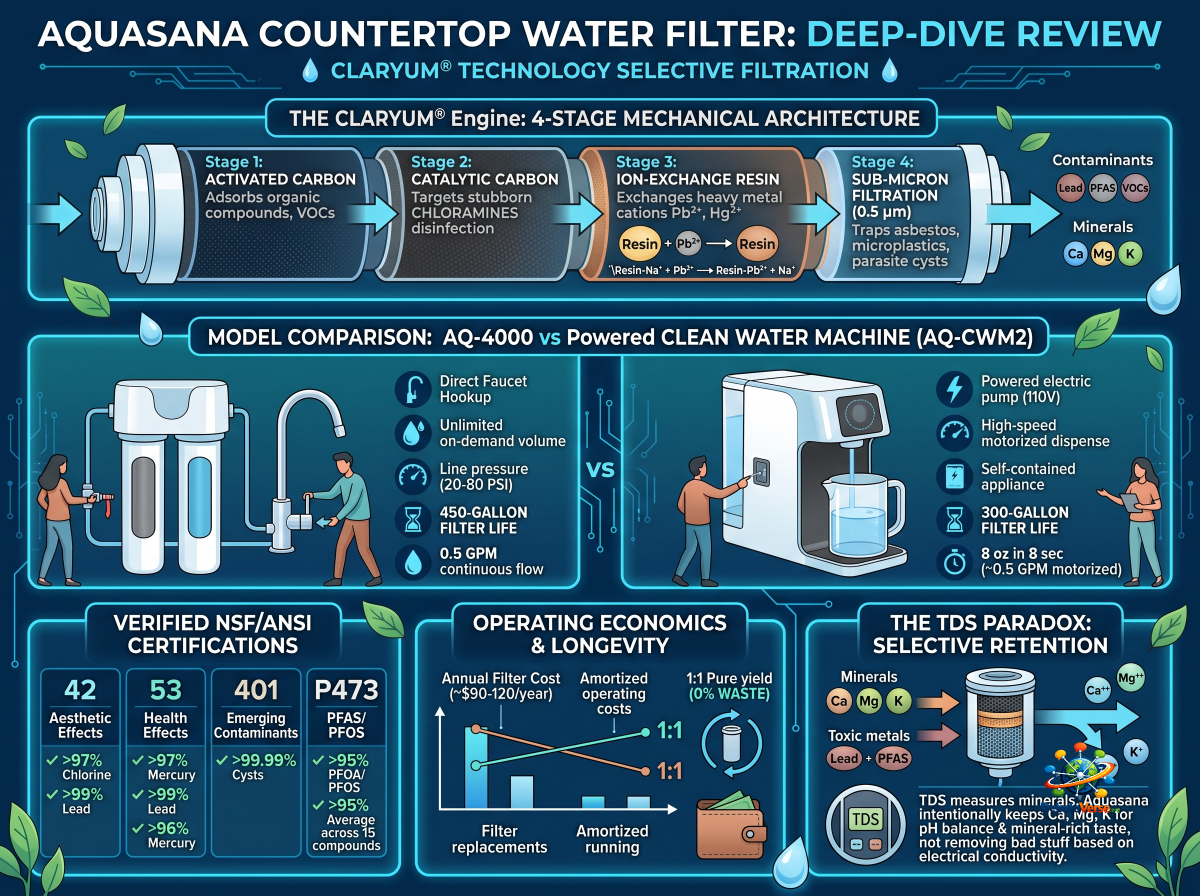
At the core of all Aquasana countertop systems is the Claryum® composite matrix. Rather than relying on a single filtration medium, Aquasana combines four distinct processing methods into a compact cartridge design:
The 4-Part Filtration Matrix Breakdown
1. Activated Carbon: Adsorbs organic compounds, pesticides, herbicides, and standard free chlorine.
2. Catalytic Carbon: Specially treated to target chloramines (the stubborn chlorine-plus-ammonia disinfectant increasingly used by municipal water treatment plants, which standard carbon blocks struggle to break down).
3. Ion-Exchange Resin: Uses ionic bonding to trap dissolved heavy metal cations (such as Lead and Mercury ):
4. Sub-Micron Mechanical Filtration (): A high-density physical barrier that traps microscopic particulates, asbestos fibers, microplastics, and chlorine-resistant parasite cysts (Cryptosporidium and Giardia).
2. Model Comparison: AQ-4000 Faucet-Diverter vs. Clean Water Machine (AQ-CWM2)
Aquasana deploys its Claryum® technology across two distinct countertop form factors. Choosing between them comes down to whether you want a direct faucet hookup or a standalone electric dispenser.
Option A: The Classic Faucet Diverter (AQ-4000)
Option B: The Powered Clean Water Machine (AQ-CWM2)
3. Verified Performance & The Selective Retention Advantage
Aquasana relies on extensive third-party laboratory testing through the Water Quality Association (WQA) and NSF International.
Independent NSF/ANSI Certifications
Both systems hold comprehensive certifications across four key health and aesthetic standards:
| Standard | What It Verifies | Aquasana Removal Rate |
|---|---|---|
| NSF/ANSI 42 | Aesthetic Impurities (Free Chlorine, Chloramines, Taste, Odor) | Chlorine Reduction |
| NSF/ANSI 53 | Known Health Hazards (Lead, Mercury, Asbestos, Cysts, VOCs) | Lead, Mercury, Cysts |
| NSF/ANSI 401 | Emerging Contaminants (Pharmaceuticals, BPA, Pesticides, DEET) | Average Reduction across 15 Compounds |
| NSF P473 | "Forever Chemicals" (PFOA, PFOS, PFAS Compounds) | PFOA / PFOS Reduction |
The TDS Paradox: Why Your TDS Meter Won't Drop
A frequent point of confusion for first-time buyers is testing Aquasana water with a handheld Total Dissolved Solids (TDS) meter. The screen will show almost no reduction compared to raw tap water.
This is intentional. Claryum® technology does not remove dissolved ionic minerals like calcium (), magnesium (), and potassium (). Because TDS meters measure electrical conductivity from dissolved ions, harmless health-promoting minerals register on the screen alongside bad ones. Aquasana selectively strips toxic heavy metals and synthetic organic compounds while keeping the healthy electrolyte minerals intact.
4. Operating Economics & Filter Longevity
Maintaining an Aquasana countertop system is straightforward, with low amortized operating costs over time compared to bottled water or high-frequency pitcher filter swaps.
| Metric | Classic Faucet Diverter (AQ-4000) | Clean Water Machine (AQ-CWM2) |
|---|---|---|
| Initial Hardware Price | ~$70 – $90 | ~$120 – $150 |
| Filter Cartridge Lifespan | 450 Gallons (~6 Months) | 300 Gallons (~6 Months) |
| Flow Rate | 0.5 GPM (at 20–80 PSI) | 8 oz per 8 seconds (~0.5 GPM motorized) |
| Power Consumption | 0 Watts (100% Non-electric) | Low-wattage 110V pump engine |
| Wastewater Ratio | 0% Waste (1:1 Pure Yield) | 0% Waste (1:1 Pure Yield) |
| Annual Filter Cost | ~$90 – $110 / year | ~$100 – $120 / year |
5. The Journalist’s Final Verdict
Aquasana’s countertop line offers robust, NSF-certified filtration without the installation footprint of under-sink RO systems or the slow speed of gravity pitchers.