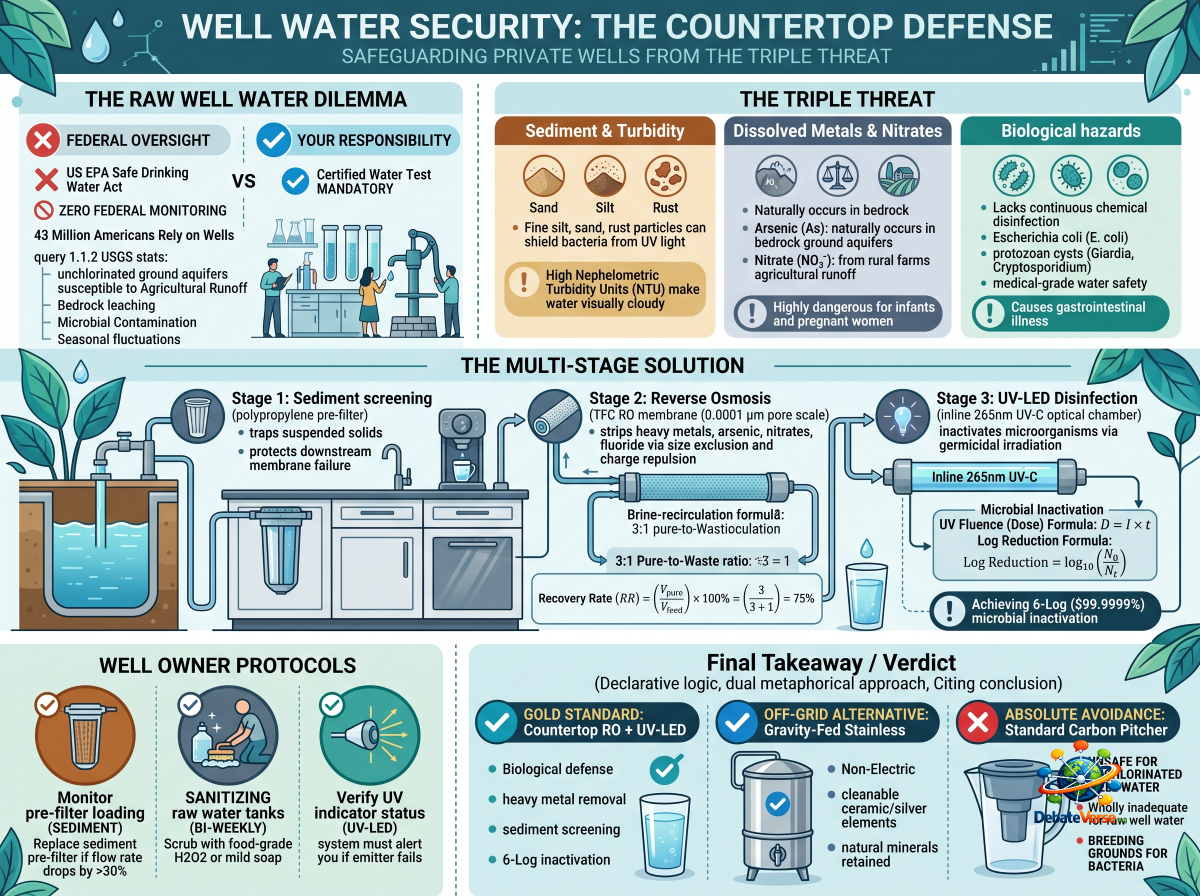
Over 43 million Americans rely on private wells for their daily drinking water. While well water frees homeowners from municipal water bills and chemical additive treatments like chloramine and fluoride, it introduces a significant safety tradeoff: zero federal oversight.
While public tap water is strictly monitored under the EPA’s Safe Drinking Water Act, private well water quality is entirely the owner's responsibility. Unchlorinated ground aquifers are highly susceptible to seasonal fluctuations, agricultural runoff, heavy metal leaching from bedrock, and microbial contamination.
Standard pour-over pitchers that rely solely on simple activated carbon filters are wholly inadequate for raw well water. Converting private well water into pure drinking water at the countertop level requires a targeted, multi-stage strategy capable of removing physical sediment, dissolved toxic minerals, and microscopic pathogens simultaneously.
=>Check out these Brand products on Amazon:
1. The Triple Threat of Raw Well Water
Treating well water differs fundamentally from treating municipal water. Where city water suffers primarily from disinfectant taste and aging pipes, well water presents three distinct tiers of contamination:
[ RAW WELL WATER CONTAMINANTS ]
 ├─ Tier 1: Physical Sediment  --> Sand, silt, clay, rust flakes (High Turbidity / NTU)
 ├─ Tier 2: Dissolved Metals   --> Arsenic, Lead, Iron, Manganese, Nitrates (Agricultural Runoff)
 └─ Tier 3: Biological Hazards --> E. coli, Coliform bacteria, Giardia, Cryptosporidium cysts
Tier 1: Turbidity & Physical Sediment
Heavy rainfall or shifts in the water table push fine silt, sand, and ferric rust particles into well casings. High turbidity measured in Nephelometric Turbidity Units (NTU) not only makes water visually cloudy, but physical particles can quickly clog fine filter pores and shield bacteria from UV light.
Tier 2: Heavy Metals & Agricultural Nitrates
Tier 3: Biological Pathogens
Because private wells lack continuous chemical disinfection (like chlorine or chloramines), subsurface contamination from septic tanks, livestock facilities, or surface flooding can introduce living pathogens directly into your drinking supply.
2. Well Water Diagnostic & Treatment Decision Matrix
Before selecting a countertop system, well owners must conduct a certified laboratory water test. The results dictate which countertop technology stack is required:
3. The Science of Multi-Stage Well Water Purification
To safely process raw well water without clogging or premature filter failure, a countertop unit must deploy a sequential barrier strategy:
Stage 1: Sediment Screening (Protecting the Core)
Before water reaches delicate membranes, a dense polypropylene pre-filter ( down to ) traps suspended solids. This preserves hydraulic flow rate and prevents physical scraping of downstream membranes.
Stage 2: Reverse Osmosis (Dissolved Ion Rejection)
Pressurized water passes through a semi-permeable thin-film composite (TFC) membrane with pores sized at approximately . This layer strips out dissolved heavy metals, arsenic, nitrates, and fluorides via size exclusion and charge repulsion.
Stage 3: UV-LED Disinfection (Biological Eradication)
For total biological security, clean water passes through an inline 265nm UV-LED optical chamber. Ultraviolet light in the UV-C spectrum penetrates microbial cell walls and alters their DNA/RNA strands, rendering bacteria, viruses, and cysts incapable of reproduction.
#### The Math of Biological Inactivation
The effectiveness of ultraviolet germicidal irradiation (UVGI) relies on UV Fluence (Dose), calculated as:
Where:
To achieve a inactivation (6-Log Reduction) of pathogenic bacteria such as Escherichia coli, the UV module must deliver a minimum fluence of .
The relationship between initial microorganism count () and surviving count () is expressed by:
A 6-Log reduction reduces active bacterial colony-forming units down to a single organism, providing true medical-grade water safety.
4. Hydraulic Sequence Diagram: Processing Well Water at the Countertop
The following sequence details how a motorized countertop RO + UV system processes raw well water from a dirty feed tank to a sterile glass:
5. Countertop System Comparison for Private Wells
Not all countertop filtration technologies are equipped to handle unchlorinated well water. The table below illustrates how different systems perform against typical well water threats:
| Filtration Technology | Sediment & Turbidity | Heavy Metals (Arsenic, Lead) | Bacteria & Viruses (Coliform/E. coli) | Nitrates & Agricultural Runoff | Electricity Required? |
|---|---|---|---|---|---|
| Standard Carbon Pitcher | Low (Clogs quickly) | Minimal () | 0% (UNSAFE) | 0% (UNSAFE) | No |
| Direct Faucet-Diverter | Moderate | Moderate () | 0% (UNSAFE) | Low () | No |
| Gravity-Fed Ceramic (e.g., Berkey) | High | High () | High (, with silver media) | Moderate () | No (Off-Grid Safe) |
| Countertop RO + UV-LED (e.g., Waterdrop A1) | Maximum (Multi-stage) | Maximum () | Maximum () | Maximum () | Yes |
6. Critical Maintenance Protocols for Well Water Owners
Well water places far higher demands on filtration hardware than treated municipal tap water. To prevent system breakdown, follow these maintenance rules:
> 1. Monitor Pre-Filter Loading (Iron & Sediment)
> High dissolved iron ( above ) will oxidize when exposed to air, forming orange ferric rust particles () that coat pre-filters. If your dispensing flow rate drops by more than , replace the sediment pre-filter immediately to protect the main pump and membrane.
> 2. Sanitize Raw Water Tanks Bi-Weekly
> Because raw well water placed in a removable countertop reservoir lacks chlorine, biofilm can grow on the tank walls within 48 to 72 hours. Scrub raw water reservoirs with food-grade hydrogen peroxide or mild dish soap twice a month.
> 3. Verify UV-LED Status Light
> Ensure your system features an active optical sensor monitoring UV output. A standard blue LED power light does not guarantee germicidal UV-C intensity; the system must alert you if the internal UV emitter fails.
The Final Verdict
If your home relies on a private well, choosing a countertop water filter is not a matter of taste preference—it is a critical public health decision.