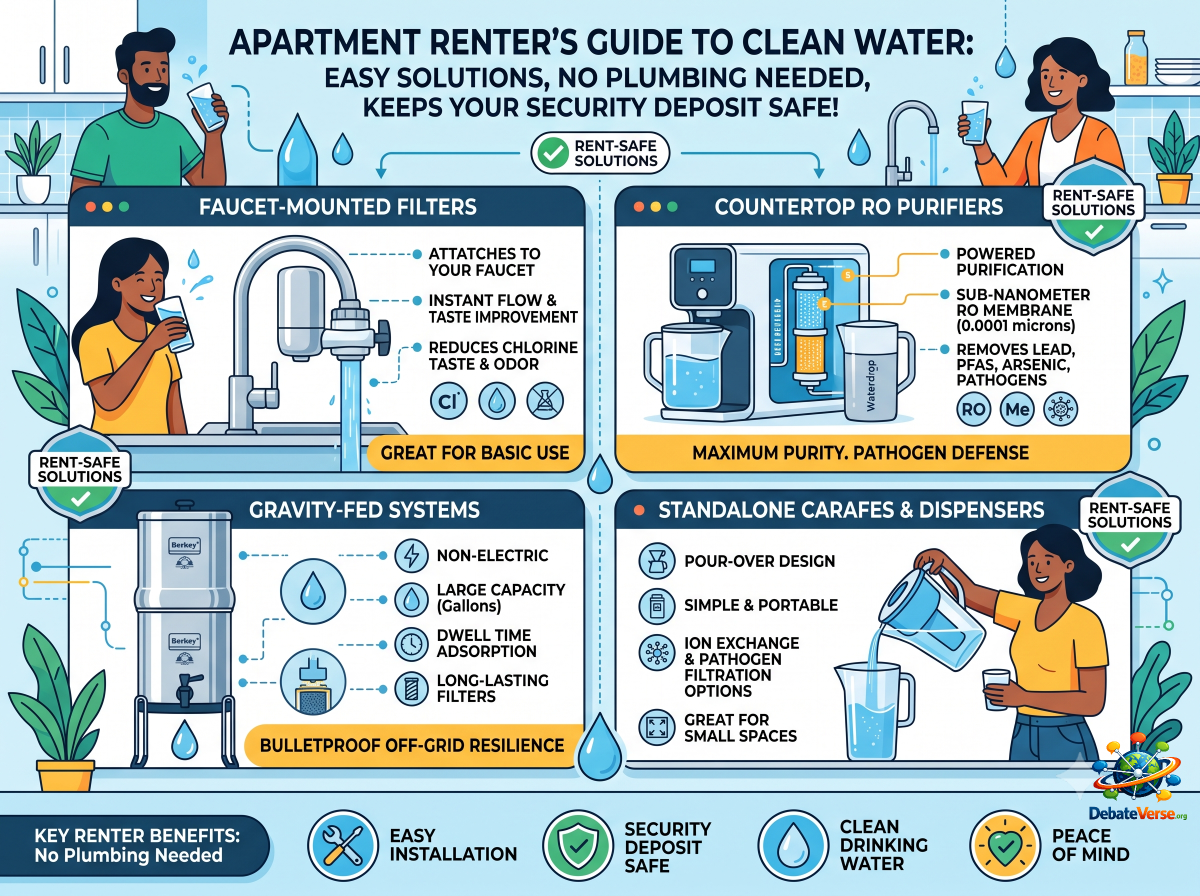
Living in a rental property often requires accepting trade-offs beyond your control: dated tile, landlord-grade appliances, and, most concerningly, aging plumbing. Whether you are dealing with lead service lines in an urban pre-war building or hard water stains in a suburban complex, tap water quality is rarely a landlord priority.
For tenants, installing a traditional under-sink Reverse Osmosis (RO) system presents an immediate barrier. Standard under-sink units require drilling a dedicated hole through the countertop for an auxiliary faucet, tapping directly into the cold water pipe with a T-adapter, and clamping a drain line into the P-trap. For anyone bound by a strict lease agreement, doing so risks forfeited security deposits or costly property damage claims.
Fortunately, modern water purification engineering has shifted dramatically toward zero-plumbing, zero-modification countertop solutions. This guide outlines how renters can achieve lab-grade drinking water purity without driving a single screw or violating a lease.
=>Check out these Brand products on Amazon:
1. The Landlord Barrier: Why Under-Sink Units Fail Renters
To understand why countertop systems are the standard for tenants, consider what a traditional under-sink installation requires—and why it triggers red flags during move-out inspections:
[ TRADITIONAL UNDER-SINK INSTALLATION ]
 ├─ Countertop Drilling   --> Requires 1.25" hole in granite/quartz/laminate (PERMANENT DAMAGE)
 ├─ Pipe Tapping         --> Splicing into main cold water supply pipe (LEAK RISK)
 ├─ Drain Saddle Clamp   --> Drilling into PVC/metal drain P-trap (PLUMBING MODIFICATION)
 └─ Electrical Wiring     --> Tying into under-sink disposals (ELECTRICAL MODIFICATION)
If a leak develops under a sink while you are at work or away for the weekend, water damage can rapidly spread to subflooring and neighboring units. Landlords routinely hold tenants financially liable for unauthorized plumbing modifications.
Countertop filtration systems solve this by creating a completely closed, non-invasive loop. Water is processed either via direct faucet diverters or self-contained, plug-and-play reservoirs.
2. Renter’s Decision Matrix: Matching System to Sink
Not all rental kitchens are built the same. The right system depends on your faucet design, counter space, and power outlet placement.
3. The Mechanics of Lease-Safe Filtration Form Factors
Renters can choose from four primary zero-plumbing form factors, each operating on different physical and hydraulic principles:
A. Faucet-Diverter Systems (e.g., Aquasana AQ-4000)
These units rest on the counter next to the sink and connect to the existing faucet aerator via a thin dual-hose line and a brass diverter valve.
B. Plug-and-Play Countertop RO (e.g., Waterdrop A1 / Lucid)
These standalone motorized appliances do not connect to your faucet at all. You fill a removable raw water tank at the tap, set it into the base, and let an internal pump process the water.
Where is volumetric flux, is the pump-generated transmembrane pressure, is osmotic pressure difference, is fluid viscosity, and is membrane resistance.
C. Gravity-Fed Cylinders (e.g., Big Berkey)
Non-electric, gravity-fed stainless steel cylinders sit on the counter or a dedicated stand.
4. Renter Comparison Matrix: Form Factors Head-to-Head
| Form Factor | Lease Safety Score | Faucet Compatibility | TDS & Heavy Metal Removal | Dispensing Speed | Portability Rating |
|---|---|---|---|---|---|
| Direct Faucet Diverter | Standard Threaded Faucets Only | Moderate-High (Carbon/Resin) | High () | High (Packs in 5 mins) | |
| Plug-and-Play RO | 100% Universal (All Faucets) | Maximum ( RO) | High (Instant motorized) | Moderate (Requires box/padding) | |
| Gravity-Fed Stainless | 100% Universal (All Faucets) | High (Adsorption/Micro-pore) | Low () | High (Durable steel body) | |
| Pour-Over Pitcher | 100% Universal (All Faucets) | Varies (Ion-exchange/Carbon) | Moderate () | Maximum (Fits in backpack) |
5. The Renter’s Move-Out Protocol: Transporting Your System
When your lease ends, taking your countertop system to your next apartment requires proper care to prevent component damage or mold growth:
> Pro Tip for Moving Day: Keep your faucet's original stock aerator in a labeled bag inside your kitchen drawer. When moving out, unscrew your diverter valve, thread the original aerator back on, and leave the sink in its exact original condition.
The Final Verdict
Being a renter no longer means settling for poor water quality or risking your security deposit on illegal plumbing modifications: