For decades, consumer water filtration was evaluated on a simple benchmark: taste. If a pitcher filter removed enough chlorine to make municipal tap water taste cleaner than pool water, it was considered a success.
Today, that baseline is dangerously obsolete.
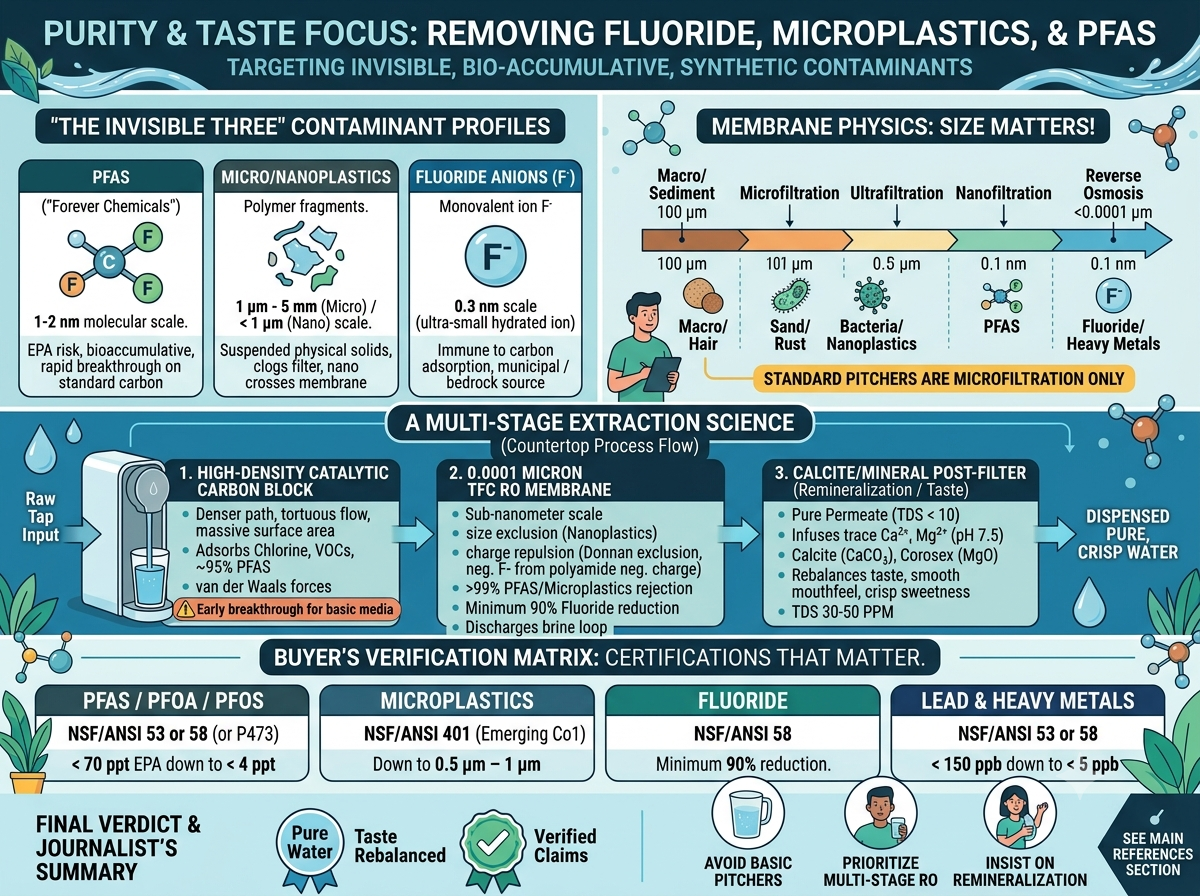
Modern drinking water analysis has exposed a new class of invisible, bio-accumulative, and synthetic contaminants that standard activated carbon pitchers were never designed to handle. Among the most concerning are PFAS ("forever chemicals"), microplastics and nanoplastics, and monovalent inorganic ions like fluoride. These substances pass through standard pitcher filters entirely unnoticed because they operate at molecular and ionic scales far below basic physical filtration thresholds.
Achieving true purity without compromising taste requires understanding the physical mechanics of extraction, membrane pore scales, and the chemical dynamics of water remineralization.
=>Check out these Brand products on Amazon:
1. The "Invisible Three": Molecular Profiles & Health Hazards
To remove modern tap water contaminants, filtration systems must target their specific molecular structures, charges, and sizes:
[ THE MODERN CONTAMINANT PROFILE ]
 ├─ PFAS / PFOA / PFOS    --> Synthetic organofluorine compounds with indestructible C-F bonds
 ├─ Micro/Nanoplastics    --> Synthetic polymer fragments ranging from 5mm down to < 100nm
 └─ Fluoride Anions (F-)  --> Highly hydrated inorganic ions with ultra-small ionic radii (~0.3nm)
| Contaminant | Typical Scale / Size | Primary Source | Extraction Challenge |
|---|---|---|---|
| PFAS / PFOA / PFOS | (Molecular length) | Industrial runoff, aqueous firefighting foam, non-stick coatings | Extremely stable carbon-fluorine bonds (); rapidly saturates basic carbon media causing early breakthrough. |
| Microplastics | Degraded synthetic textiles, plastic bottles, urban dust | Suspended physical solids; clogs fine filters quickly if pre-filtration is inadequate. | |
| Nanoplastics | () | Mechanical breakdown of microplastics | Capable of crossing biological membranes; requires sub-micron size exclusion. |
| Fluoride () | () | Municipal fluoridation, natural bedrock leaching | Monovalent negative charge; immune to standard carbon adsorption. |
Per- and Polyfluoroalkyl Substances (PFAS)
PFAS are a class of thousands of synthetic organofluorine compounds known as "forever chemicals." Their defining characteristic is the carbon-fluorine () bond—one of the strongest single bonds in organic chemistry. Because these molecules do not degrade naturally in the environment or the human body, they bioaccumulate in human blood serum and organ tissue, linked by the EPA to thyroid disease, kidney cancer, and immune system suppression.
Microplastics & Nanoplastics
Recent laboratory studies have revealed that tap water worldwide contains microscopic polymer particles derived from synthetic textiles, packaging, and industrial degradation. While microplastics () are trapped by fine physical filters, nanoplastics () present a severe biological threat due to their ability to cross the intestinal wall and enter human blood circulation.
Fluoride ()
Added to municipal water supplies as fluorosilicic acid () or sodium fluoride (), fluoride dissociates into single inorganic fluoride anions (). With a hydrated ionic radius of approximately , fluoride ions easily slip through standard carbon block pores.
2. Membrane Physics: Matching Contaminant Scale to Pore Size
Understanding water purification requires visualizing the vast difference in size between visible debris, microscopic pathogens, and dissolved molecular compounds:
Standard pour-over pitchers rely almost exclusively on Granular Activated Carbon (GAC) operating in the Microfiltration zone (). While effective for chlorine taste, they leave PFAS, nanoplastics, and fluoride virtually untouched.
3. Extraction Science: How Modern Countertop Systems Filter the Invisible
To eliminate these persistent compounds, multi-stage countertop RO systems deploy a sequence of targeted chemical and physical extraction mechanisms.
1. High-Density Catalytic Carbon Blocks (PFAS Adsorption)
While basic GAC allows water to channel around carbon granules, compressed catalytic carbon blocks force water through a tortuous path with massive surface area. A single gram of high-grade activated carbon features an internal surface area exceeding . PFAS molecules adhere to the hydrophobic carbon surface via van der Waals forces.
2. Reverse Osmosis Size Exclusion & Charge Repulsion (Fluoride & Nanoplastics)
The core engine for removing fluoride and nanoplastics is the Thin-Film Composite (TFC) RO membrane. Operating with an ultra-fine pore scale of (), the membrane physically blocks nanoplastics through size exclusion.
For tiny, dissolved fluoride ions (), the membrane utilizes charge repulsion (Donnan exclusion). The polyamide material of an RO membrane carries a net negative surface charge in aqueous solutions, actively repelling negatively charged fluoride anions away from the membrane boundary.
Measuring Rejection Efficiency
The mathematical removal efficiency () of a filtration membrane for a specific contaminant is calculated as:
Where:
To earn independent certification for PFAS and fluoride reduction, advanced countertop RO systems maintain an and .
4. Taste & The Remineralization Paradox
A common complaint regarding pure Reverse Osmosis water is that it tastes "flat," "dead," or slightly acidic.
When an RO membrane strips away dissolved solids (reducing Total Dissolved Solids / TDS from 300 PPM down to ), it removes dissolved mineral ions along with contaminants. Water deprived of minerals easily absorbs carbon dioxide () from the air, forming weak carbonic acid () and dropping the water's pH from a neutral 7.0 down to an acidic 5.8–6.2:
Rebalancing Taste with Remineralization
Premium countertop RO appliances resolve this issue by routing purified permeate through a post-filtration remineralization cartridge. This stage passes purified water over food-grade calcite (calcium carbonate, ) and corosex (magnesium oxide, ).
[ REMINERALIZATION BALANCING LOOP ]
 Pure RO Permeate (pH 6.0, TDS < 10)
         │
         ▼
 [ Remineralization Media: CaCO3 + MgO ]
         │
         ▼
 Alkaline Remineralized Water (pH 7.5, TDS 30-50, Rich in Ca2+ / Mg2+)
This controlled dissolution reintroduces essential alkaline minerals in trace quantities ( TDS):
5. The Buyer's Verification Matrix: Certifications That Matter
When purchasing a countertop system specifically targeting PFAS, fluoride, or microplastics, marketing claims on a box are insufficient. Look for independent testing verified under official NSF/ANSI Standards:
| Target Contaminant | Required NSF/ANSI Certification Standard | Testing Benchmark & Threshold |
|---|---|---|
| PFAS / PFOA / PFOS | NSF/ANSI 53 or NSF/ANSI 58 (or P473) | Reduces PFOA/PFOS below the EPA health advisory limit (, down to ). |
| Microplastics | NSF/ANSI 401 (Emerging Compounds) | Verifies removal of microplastics down to . |
| Fluoride | NSF/ANSI 58 (Reverse Osmosis Systems) | Guarantees a minimum of reduction in dissolved inorganic fluoride. |
| Lead & Heavy Metals | NSF/ANSI 53 or NSF/ANSI 58 | Reduces lead concentration from down to . |
The Final Verdict
If your hydration priority is targeting modern chemical contaminants and microplastics without sacrificing water taste:
1. Avoid Standard Carbon Pitchers: Basic pour-over pitchers lack the membrane density and dwell time required to stop PFAS breakthrough or reject tiny fluoride ions.
2. Prioritize Multi-Stage RO Systems: Reverse Osmosis remains the single most reliable, residential-scale barrier against the combined threat of PFAS, microplastics, and fluoride.
3. Insist on Remineralization: Choose a system featuring an integrated remineralization post-filter to protect your water's pH balance, guard against acidity, and deliver a crisp, mineral-rich taste profile.
Main References:
1. U.S. Environmental Protection Agency (EPA). (2024). Per- and Polyfluoroalkyl Substances (PFAS) National Primary Drinking Water Regulation. EPA 816-F-24-001.
2. NSF International. (2023). NSF/ANSI Standard 58: Reverse Osmosis Drinking Water Treatment Systems. Ann Arbor, MI: NSF International.
3. World Health Organization (WHO). (2022). Dietary and Non-Dietary Exposure to Microplastics and Nanoplastics: Health Implications for Human Drinking Water. WHO Guidelines for Drinking-Water Quality.
4. American Water Works Association (AWWA). (2021). Water Fluoridation Principles and Practices (M41). AWWA Manual of Water Supply Practices, 6th Ed.
5. Mason, S. A., et al. (2018). Synthetic Polymer Contamination in Global Bottled and Tap Water. Frontiers in Chemistry, 6, 407.