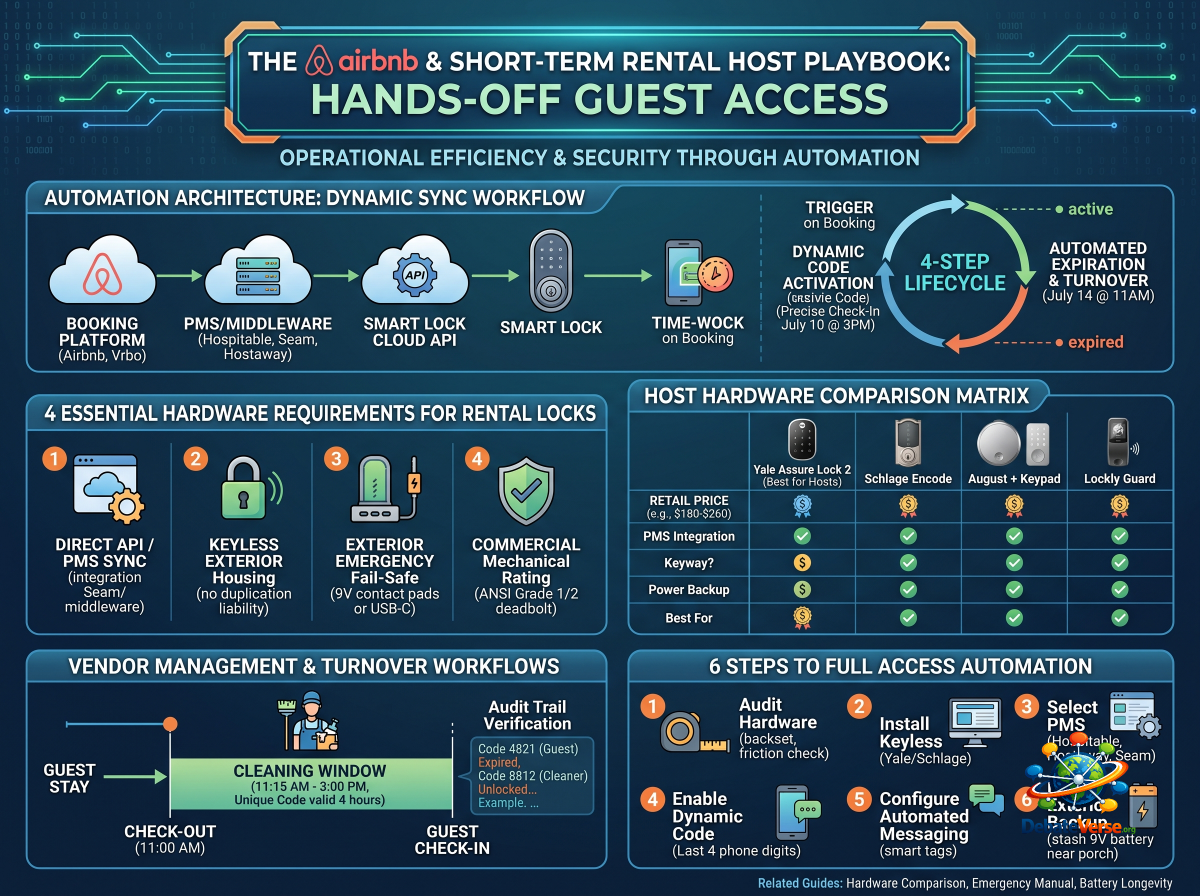
For short-term rental hosts and property managers, front-door access is the single biggest operational friction point. A lost physical key, a frozen lockbox combination in sub-zero weather, or a delayed late-night flight can turn an otherwise 5-star guest review into a middle-of-the-night emergency phone call.
Beyond guest convenience lies a critical security issue: static access codes. Leaving the same 4-digit PIN on a lockbox or entry keypad for months at a time means previous guests, cleaning contractors, and maintenance workers retain unlimited access to your property long after their stay concludes.
The solution is a fully automated, hands-off guest access workflow. By linking smart hardware directly to short-term rental platforms and Property Management Systems (PMS), hosts can automatically generate dynamic, time-bound access PINs that activate precisely at check-in and expire instantly at check-out.
Here is our lab's comprehensive playbook for configuring a zero-friction, highly secure access stack for your vacation rental portfolio.
1. The Automation Architecture: How Dynamic Sync Works
Modern vacation rental access relies on cloud-to-cloud API integrations between booking platforms (like Airbnb and Vrbo), management middleware (like Hospitable, Hostaway, or Guesty), access control platforms (like Seam or Opera), and your smart lock's Wi-Fi or hub bridge.
The 4-Step Lifecyle of an Automated Guest PIN:
1. Trigger on Reservation: The moment a guest completes a booking, the PMS extracts the guest's phone number.
2. Dynamic Code Generation: The system automatically selects the last 4 digits of the phone number as the PIN (making it effortless for the guest to remember).
3. Time-Bound Activation: The code is pushed to the door lock's internal memory but remains inactive until the exact minute of scheduled check-in (e.g., 3:00 PM).
4. Automated Expiration & Turnover Trigger: At check-out time (e.g., 11:00 AM), the guest PIN is wiped from the lock's memory. Simultaneously, a temporary vendor PIN activates for the cleaning crew to perform turnover.
2. Essential Hardware Requirements for Rental Smart Locks
Not every consumer smart lock is built to withstand the demands of a high-turnover rental property. When evaluating hardware for an Airbnb or Vrbo, ensure the lock meets four strict criteria:
1. Keyless Exterior Housing (No Lock Cylinders)
While traditional homeowners often prefer having a physical backup keyway, keyholes are a liability for short-term rentals. Guests frequently lose physical backup keys, duplicate them without authorization, or jam foreign objects into the cylinder. A completely keyless touchscreen or keypad removes key management entirely.
2. Exterior Emergency Power Fail-Safe
If a guest arrives at midnight and the lock's internal batteries have died, a keyless lock must provide external jump-start access. Look for models with exterior 9V battery contacts (like the Yale Assure Lock 2) or an emergency USB-C port (like the Aqara U100). A traveler can press a standard 9V battery against the contacts to power up the keypad and enter their PIN within seconds.
3. Built-In Offline Memory
Internet outages happen. The lock hardware must store time-bound PIN codes locally in its onboard flash memory rather than relying on a live, real-time Wi-Fi connection to authorize access when a guest punches in their code at the door.
3. Host Hardware Comparison Matrix
The following table evaluates the top smart locks optimized for vacation rental automation across pricing, connectivity, and management platform support:
| Lock Model | Retail Price | Native PMS Integration | Exterior Keyway? | Emergency Power Backup | Recommended Protocol | Best For |
|---|---|---|---|---|---|---|
| Yale Assure Lock 2 (Key-Free) | $180 – $260 | Native Airbnb Sync + Hospitable/Guesty | No (Completely Keyless) | 9V Battery Contact Pads | Wi-Fi or Z-Wave | Overall Best for Airbnb Hosts |
| Schlage Encode Smart Wi-Fi | $270 – $300 | Direct Airbnb Sync + Seam API | Yes (Standard Key Cylinder) | Physical Key Override | Direct Wi-Fi | High-Traffic Standalone Homes |
| August Smart Lock + Keypad | $200 – $240 | Yale Access / Airbnb Sync | Yes (Uses Existing Exterior) | Existing Exterior Key | Bluetooth + Wi-Fi | Renter-Hosted Short-Term Rentals |
| Lockly Guard Flex Touch | $280 – $350 | LocklyPro API / PMS Middleware | Yes (Concealed Keyway) | 9V Contact Pads | Wi-Fi / RFID | Luxury Multi-Unit Properties |
4. Vendor Management & Turnover Workflows
Managing guest access is only half the battle; coordinating housekeepers, maintenance technicians, and property inspectors requires dedicated access rules.
                  TURNOVER SCHEDULE & ACCESS WINDOWS

  11:00 AM                        11:15 AM                         3:00 PM
  ┌───────────────────────────────┬────────────────────────────────┐
  │   GUEST PIN EXPIRES           │   CLEANING CREW PIN ACTIVATES  │
  │   Guest PIN: Auto-Wiped       │   Cleaner PIN: Valid 4 Hours   │
  └───────────────────────────────┴────────────────────────────────┘
                                  ▲
                                  │
                       Turnover Alert Sent to Host
1. Unique Cleaning Crew PINs
Never give your turnover team a static master PIN that works 24/7. Assign each cleaner or vendor an individual schedule-restricted PIN that only operates during your standard turnover window (e.g., 11:00 AM to 3:00 PM on booked days).
2. Audit Trail Verification
Smart lock activity logs provide undeniable proof in host-guest disputes. If a guest claims they were forced to check out early due to unit issues, or if a cleaner claims they completed a turnover on time, the lock’s timestamped audit trail records every bolt retraction:
5. The Complete Host Setup Checklist
Follow this implementation roadmap to transition your short-term rental from manual key handoffs to a fully automated system:
1. Audit Your Door Hardware: Measure backset, door thickness, and cross-bore holes to ensure standard deadbolt compatibility. Ensure the door frame strike plate is filed down so the bolt throws without mechanical friction.
2. Install Keyless Hardware: Select a keyless model like the Yale Assure Lock 2 Key-Free Touchscreen or Schlage Encode.
3. Select Your PMS / Middleware: Connect your Airbnb/Vrbo account to an automation service like Hospitable, Hostaway, or Seam.co.
4. Enable Dynamic Code Generation: Set the code generation rule to `Last 4 Digits of Phone Number` and set check-in/check-out buffer padding (e.g., activate code 15 minutes prior to check-in).
5. Configure Automated Guest Messaging: Add smart tags to your post-booking messaging template:
> "Welcome to the property! Your personalized keyless entry PIN is [guest_phone_last4]. Your code will become active at check-in time ([checkin_time] on [checkin_date]). To unlock, enter your PIN on the keypad followed by the Check/Lock button."
6. Mount an Exterior Backup Emergency Stash: Install a concealed weather-resistant box near the porch with a fresh 9V battery and basic operating instructions in case the lock's internal batteries hit zero unexpectedly.