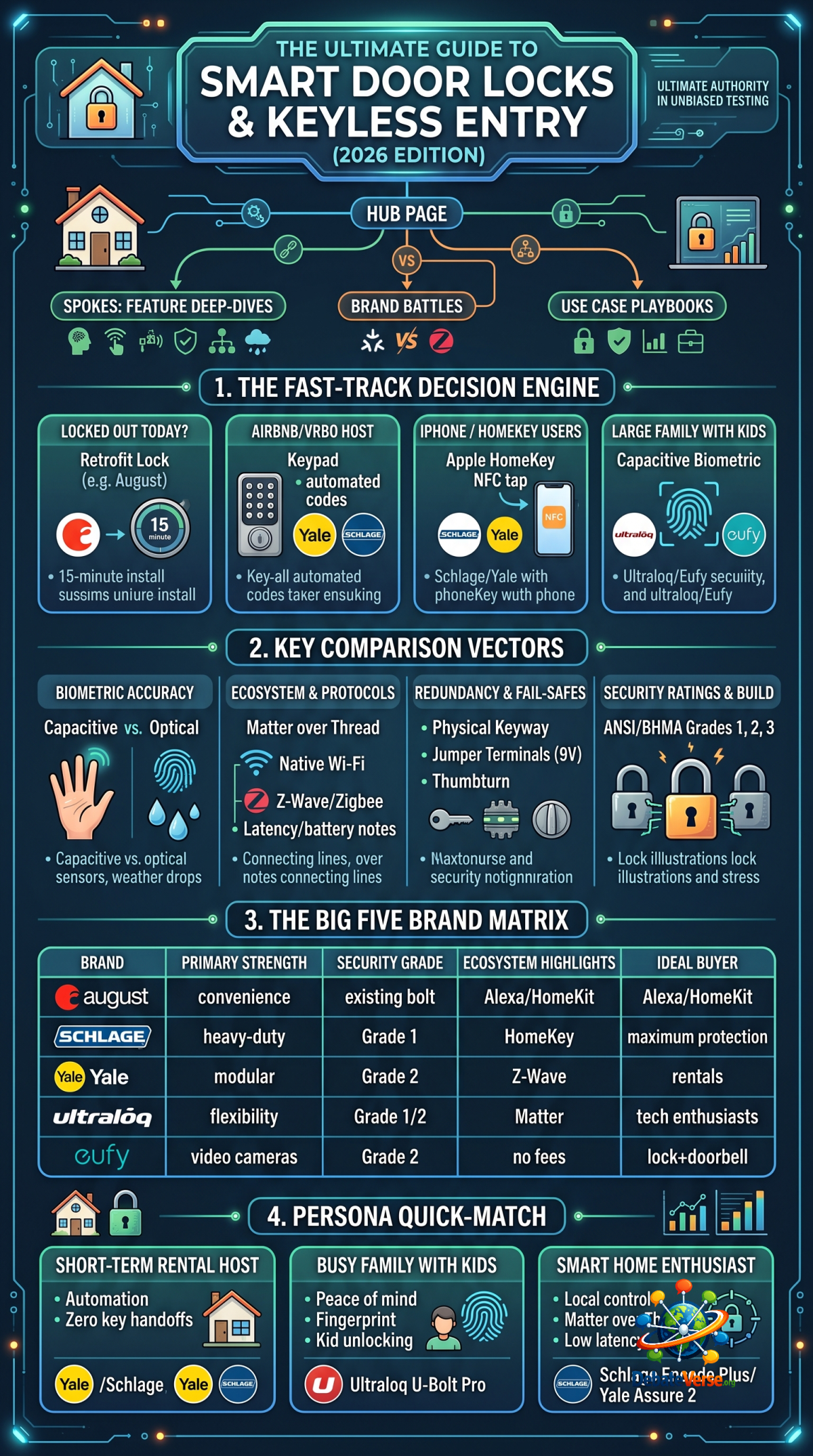
Upgrading the primary deadbolt on your home is equal parts convenience and security. A decade ago, smart locks were notorious for finicky Wi-Fi bridges, sluggish Bluetooth connections, and battery drain that left homeowners stranded. Today, with the maturation of Apple HomeKey (NFC), Matter over Thread, and capacitive biometric sensors, keyless entry has evolved from an enthusiast gimmick into an essential home upgrade.
Whether you are standing outside locked out right now, running a multi-property short-term rental business, or looking to give your middle-schoolers easy after-school access, this guide breaks down the hardware, protocols, and performance benchmarks that actually matter.
1. The Fast-Track Decision Engine
If you are facing an immediate hardware replacement or need to solve a specific problem today, use this triage engine to pinpoint your best starting option:
Look for a retrofit lock (like the August Wi-Fi Smart Lock). Retrofit locks install on the interior side of your door in under 15 minutes, allowing you to keep your existing exterior cylinder, keys, and exterior deadbolt housing intact.
Prioritize a keypad lock with native Property Management System (PMS) integration (such as the Yale Assure Lock 2 or Schlage Encode). You need automated code generation that activates at check-in and expires automatically at check-out without requiring guest app downloads.
Choose an Apple HomeKey-enabled deadbolt (like the Schlage Encode Plus or Yale Assure Lock 2 with HomeKey). Tap-to-unlock via NFC works even if your phone battery dies, using reserve power in the iPhone's Secure Element.
Select a capacitive biometric lock with a physical key override (such as the Ultraloq U-Bolt Pro or Eufy Smart Lock C220). Fingerprints eliminate forgotten PIN codes, while the physical key cylinder offers absolute peace of mind.
2. Key Comparison Vectors: How We Benchmark Smart Locks
Not all smart locks are engineered to the same security standards or connection protocols. When testing and reviewing hardware, we evaluate four core performance vectors:
Biometric Accuracy & Sensor Tech
Biometric scanners come in two primary types:
Ecosystem Integration & Protocols
How your lock talks to your smart home dictates battery life and response latency:
Redundancy & Physical Security Fail-Safes
A dead battery should never trap you outside. We require every top-tier recommendation to include at least two of the following fail-safes:
1. Physical Keyway: Standard 5-pin cylinder (preferably re-keyable to Schlage C or Kwikset KW1 keyways).
2. Exterior Jumper Terminals: A 9V battery contact pad on the underside of the exterior keypad to temporarily jump-start a dead lock.
3. Mechanical Thumbturn: Unrestricted manual operation from the interior during power or motor failures.
Security Ratings & Build Quality
Look for ANSI/BHMA (American National Standards Institute) certification:
3. The Big Five Brand Matrix
To simplify your shopping, here is how the top five manufacturers stack up across price, hardware security, and key features:
| Brand | Primary Strength | Security Grade | Ecosystem Highlights | Ideal Buyer |
|---|---|---|---|---|
| Schlage | Heavy-duty build quality & Grade 1 security | ANSI Grade 1 | Apple HomeKey, Matter, Ring, Alexa | Homeowners wanting maximum physical protection |
| Yale | Modular connectivity & sleek architecture | ANSI Grade 2 | Apple HomeKey, Matter, Z-Wave, Airbnb native | Rental hosts & modern aesthetic enthusiasts |
| August | Non-destructive retrofit installation | Uses existing deadbolt | Alexa, Google Assistant, HomeKit | Apartment renters & DIY installers |
| Ultraloq | Unmatched unlocking flexibility (6-in-1) | ANSI Grade 1 / Grade 2 | Fingerprint, Keypad, Matter, Auto-unlock | Tech enthusiasts & multi-person households |
| Eufy | Integrated video cameras & zero monthly fees | ANSI Grade 2 | Integrated 2K Video, Biometrics, Eufy Ecosystem | Budget-conscious buyers wanting lock + doorbell in one |
4. Persona Quick-Match: Finding Your Solution
> Rule of Thumb: Before buying, measure your door's backset (distance from door edge to center of deadbolt hole — typically 2-3/8" or 2-3/4") and door thickness (standard is 1-3/8" to 1-3/4"). Most modern locks adjust for both, but custom doors require double-checking.