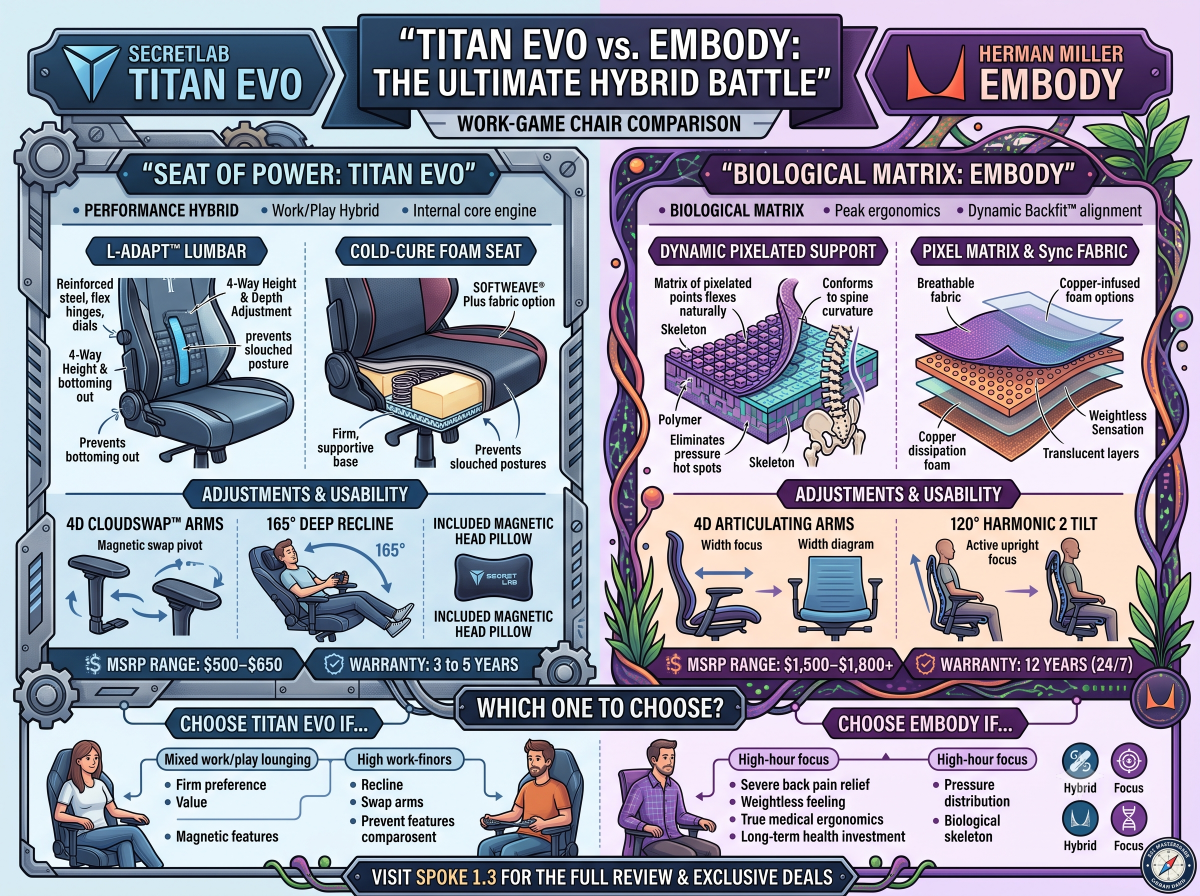
For professionals who split their time between 8-hour software development or corporate shifts and multi-hour evening gaming sessions, choosing a chair often comes down to a fundamental dilemma: Should you buy a feature-packed gaming hybrid or invest in high-end medical ergonomics?
The Secretlab Titan Evo ($500–$650) and the Herman Miller Embody ($1,500–$1,800+) represent the apex of their respective categories. Secretlab has elevated the traditional gaming seat by replacing gimmicky racing cushions with internal 4-way lumbar mechanics and firm cold-cure foam. Herman Miller, working alongside orthopedic specialists, engineered the Embody to actively improve blood circulation and mirror the human spine.
> Direct Answer / Quick Verdict:
> Choose the Secretlab Titan Evo if you want an all-in-one work-and-play seat with a deep recline (up to 165°), an included magnetic memory foam pillow, firm supportive cushioning, and high-end features at a mid-tier price point. Choose the Herman Miller Embody if you suffer from severe back pain, sit for 10+ hours of continuous deep focus work, require active spinal pressure distribution, and want a 12-year warranty investment.
If you are evaluating how these models fit into a complete workstation strategy, start with our master Ultimate Ergonomic Office Chair Buyer’s Guide to review essential posture calibration vectors.
At-a-Glance Comparison Matrix
| Vector / Feature | Secretlab Titan Evo | Herman Miller Embody (Incl. Logitech G Edition) |
|---|---|---|
| MSRP Range | $549 – $649 | $1,795 – $1,995 |
| Primary Material | SoftWeave® Plus Fabric or NEO™ Leatherette | Sync Fabric over Pixelated Polymer Matrix |
| Lumbar Mechanism | Internal L-ADAPT™ 4-Way System (Height & Depth) | Dynamic Backfit™ Spine Alignment & Pixel Matrix |
| Seat Pan Construction | Pebble Seat Base (Cold-Cure Molded Foam) | Dynamic Matrix Suspension + Copper-Infused Foam |
| Armrest Articulation | 4D Articulation with CloudSwap™ Magnetic Tops | 4D Articulation (Height, Width, Depth, Pivot) |
| Recline Capability | 165° Multi-Tilt Recline with Angle Lock | Balanced Harmonic 2 Tilt (Synchronized Recline) |
| Headrest Integration | Magnetic Memory Foam Pillow Included | None (Optional Third-Party Add-ons Available) |
| Target Persona | Hybrid Gamer-Programmers & WFH Power Users | Software Engineers, Architects & High-Hour Users |
| Warranty Coverage | 3 to 5 Years (With social extension) | 12 Years (24/7 Multi-Shift Coverage) |
Design Philosophy: Performance Hybrid vs. Biological Engineering
SECRETLAB TITAN EVO                   HERMAN MILLER EMBODY
  [ Work / Play Hybrid ]                [ Biological Matrix ]
  • Cold-cure firm foam base            • Flexible matrix of pixel points
  • Built-in L-ADAPT 4-way lumbar       • Backfit spine-tracking adjustment
  • Deep 165° recline range             • Narrow back for chest expansion
Secretlab Titan Evo: The Modern Performance Hybrid
Secretlab built the Titan Evo to break free from the negative stereotypes of cheap "bucket-seat" gaming chairs. Rather than relying on external strap-on pillows that slip out of position, the Titan Evo integrates a mechanical lumbar engine directly into its steel-reinforced backrest.
Its design language strikes a balance between gamer aesthetics and modern workspace design. With clean stitching, subtle branding, and ergonomic shaping, it transitions easily from a Zoom video call to an intense competitive gaming session.
Herman Miller Embody: Dynamic Biological Alignment
Co-designed by Bill Stumpf (the original designer of the Aeron) and Jeff Weber, the Embody was built specifically to solve the health risks of static sitting. The backrest resembles a human spinal column, featuring an exposed matrix of flexible polymer pixels that react to your micro-movements.
The narrow backrest frame allows your shoulders to open naturally, promoting chest expansion and increased oxygen intake during long periods at your desk. Whether you choose the standard Embody or the Logitech G co-branded edition (which adds a copper-infused foam cooling layer), the chair prioritizes biomechanical health over casual lounging.
> 🔗 Related Article: Full-Time Gamers vs. Work-From-Home: Gaming Chairs vs. True Ergonomic Chairs
Lumbar Mechanics & Pressure Distribution
The defining functional difference between these two flagship seats lies in how they distribute your weight and support the lumbar curve.
                  LUMBAR & SPINE SUPPORT MECHANICS
  ┌─────────────────────────────┬─────────────────────────────┐
  │   TITAN EVO (L-ADAPT™)      │   EMBODY (PIXEL MATRIX)     │
  ├─────────────────────────────┼─────────────────────────────┤
  │ • Dual-dial mechanical core │ • Matrix of pixelated points│
  │ • Adjusts height and depth  │ • Backfit tracks spine curve│
  │ • Rigid spinal support      │ • Dynamic micro-movement    │
  └─────────────────────────────┴─────────────────────────────┘
Secretlab L-ADAPT™ 4-Way Lumbar System
The Titan Evo uses internal flex-hinges controlled by two rotary knobs on the sides of the backrest:
Sensation: The Titan Evo provides a firm, structured barrier against slouched posture. It enforces lower back curve through dense cold-cure foam padding.
Herman Miller Dynamic Pixelated Support
The Embody uses no manual lumbar pads or internal foam wedges. Instead, the seat and backrest are composed of a matrix of pixelated points suspended from a central skeleton:
Sensation: Sitting in the Embody feels weightless. It eliminates pressure hot spots, allowing software engineers to work through 10+ hour coding sessions without physical fatigue.
> 🔗 Related Article: The Best Ergonomic Chairs for Software Engineers (10+ Hour Focus Sessions)
Material Engineering: Cold-Cure Foam vs. Suspension Sync Fabric
Secretlab Seat Base:
[ Cold-Cure Molded Foam ] ──► Medium-Firm Base / Prevents Bottoming Out

Embody Seat Base:
[ Sync Fabric ] ──► [ Translucent Layer ] ──► [ Matrix Suspension Points ]
> 🔗 Related Article: Mesh vs. High-Density Foam: Which Seat Material Prevents Back Strain?
Recline Dynamics, Armrests & Usability
                      RECLINE RANGE COMPARISON
  ┌─────────────────────────────────────────────────────────────┐
  │ Titan Evo: 165° Deep Recline + Multi-Tilt Lock (Lounging)    │
  │ Embody: 120° Balanced Harmonic 2 Tilt (Active Working)     │
  └─────────────────────────────────────────────────────────────┘
Recline Flexibility
Armrest Functionality
Final Verdict: Which High-End Seat Wins?
Choose the Secretlab Titan Evo if:
Choose the Herman Miller Embody if:
Frequently Asked Questions (FAQ)
Is the Logitech G Embody different from the standard Herman Miller Embody?
Yes, but the core frame structure is identical. The Logitech G Embody includes an additional copper-infused foam layer underneath the Sync fabric to enhance thermal dissipation, unique colorway options (such as Cyan accents), and subtle gaming branding. Biomechanically, both versions deliver the same pixelated matrix support.
Is the Secretlab Titan Evo too firm for long working shifts?
Secretlab chairs are intentionally engineered with medium-firm cold-cure foam to promote proper spinal posture and prevent tailbone bottoming. While it may feel firmer than traditional office chairs during the first few days, this firmness prevents slouched postures during extended work shifts.
Why doesn't the Herman Miller Embody include a headrest?
Herman Miller designs task chairs to encourage active upright sitting where head support is functionally unnecessary. However, if you prefer a headrest for reclined viewing, high-quality third-party headrests (such as those engineered by Atlas Headrest) are designed specifically to mount onto the Embody frame.