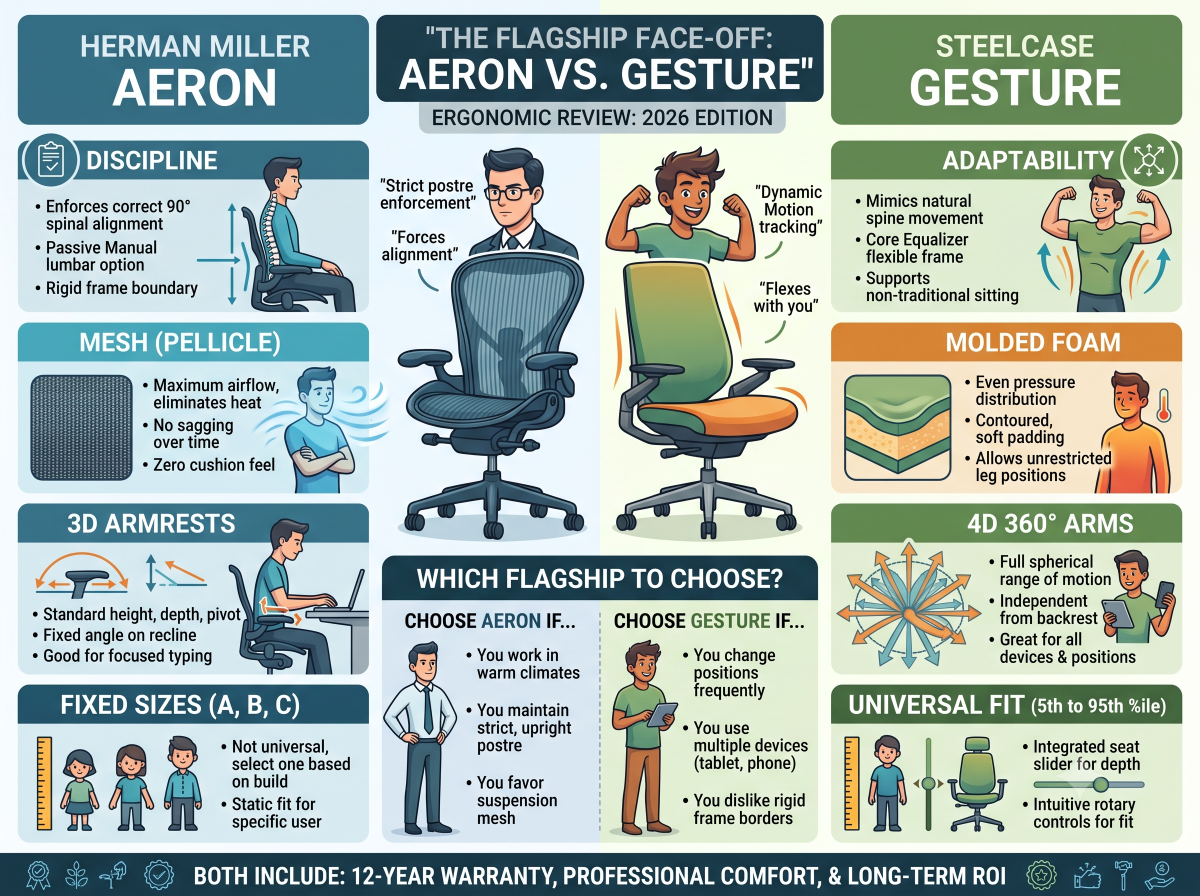
When investing upwards of $1,300 in a high-performance ergonomic work chair, the market inevitably narrows to two dominant flagships: the Herman Miller Aeron and the Steelcase Gesture. Both represent the benchmark of modern office seating engineering, backed by 12-year manufacturer warranties. However, they rely on fundamentally opposite design philosophies.
The Aeron enforces active upright posture through rigid structural boundaries and suspension mesh. The Gesture adapts to fluid, non-traditional body positions using hyper-adjustable components and dense foam padding.
> Direct Answer / Quick Verdict:
> Choose the Herman Miller Aeron if you run warm, want strict upright posture correction, and prefer a dynamic mesh suspension seat. Choose the Steelcase Gesture if you shift sitting positions frequently (e.g., cross-legged or leaning), use multiple devices (tablets/phones), or require 360-degree adjustable armrests.
If you are beginning your workspace ergonomics research, explore our Ultimate Ergonomic Office Chair Buyer’s Guide to understand the foundational posture vectors before committing to a flagship investment.
At-a-Glance Comparison Matrix
| Vector / Feature | Herman Miller Aeron | Steelcase Gesture |
|---|---|---|
| Price Point | $1,250 – $1,800+ | $1,350 – $1,650+ |
| Primary Material | 8Z Pellicle Elastomeric Mesh | High-Density Molded Foam & Upholstery |
| Fit System | Fixed Shell Sizes (Size A, B, C) | Universal Fit (5th to 95th Percentile) |
| Armrest Articulation | 3D (Height, Depth, Pivot Angle) | 4D 360-Degree Spherical Articulation |
| Lumbar Mechanism | PostureFit SL (Sacral/Lumbar Pads) | Core Equalizer / LiveBack Dynamic Frame |
| Forward Tilt Option | Yes (5-Degree Forward Angle) | No |
| Target Sitting Style | Strict Upright / Focused Task Work | Dynamic / Multi-Posture / Reclined |
| Warranty Coverage | 12 Years (Parts, Labor, Mesh) | 12 Years (Parts, Labor, Mechanisms) |
Posture Support: Upright Discipline vs. Dynamic Flexibility
The primary distinction between the Aeron and the Gesture lies in how their underlying frames handle lumbar support and spinal articulation.
HERMAN MILLER AERON                   STEELCASE GESTURE
  [ Posture Enforcement ]               [ Posture Adaptability ]
  • Forces 90° spinal alignment         • Flexes with natural body shifts
  • Rigid perimeter frame               • Flexible seat edge & backrest
  • Discourages slouched posture        • Supports cross-legged & leaning
Herman Miller Aeron: Strict Ergonomic Enforcement
The Aeron treats posture as a precise anatomical discipline. Its 8Z Pellicle suspension mesh incorporates eight distinct tension zones—firmer at the perimeter to stabilize the pelvis, and softer toward the center to cushion the sit-bones (ischial tuberosities).
When configured with the optional PostureFit SL system, the Aeron provides dual-pad stabilization for both the sacrum (base of the spine) and the lumbar curve. However, this support comes with strict boundaries. The rigid plastic frame that suspends the mesh will press against your thighs or hips if you slouch, cross your legs, or lean sideways. The Aeron does not conform to you; it trains you to maintain optimal 90-degree alignment.
Steelcase Gesture: Motion-Tracking Spine Adaptability
Steelcase engineered the Gesture following a global study analyzing over 2,000 workers across diverse industries. The study revealed that modern multi-device workflows (smartphones, tablets, dual-monitor rigs) cause users to adopt non-traditional postures that standard task chairs fail to support.
The Gesture’s LiveBack frame mimics the natural movement of the human spine, flexing dynamically as you change angles. The seat pan features flexible perimeter edges that bend under leg pressure, eliminating popliteal circulation pinch behind the knees. Whether you sit upright, recline deeply, curl one leg under your thigh, or lean sideways, the Gesture moves with your body without compromising lumbar engagement.
> 🔗 Related Article: Lumbar Support Decoded: Passive, Dynamic, and Adjustable Systems Explained
Material Science: Breathable Mesh vs. High-Density Foam
Material choice dictates thermal regulation, pressure distribution, and long-term seat durability.
                  MATERIAL SELECTION PROFILE
  ┌─────────────────────────────┬─────────────────────────────┐
  │   8Z PELLICLE MESH (AERON)  │     MOLDED FOAM (GESTURE)   │
  ├─────────────────────────────┼─────────────────────────────┤
  │ • Maximum Airflow & Cooling │ • Uniform Pressure Relief   │
  │ • Zero Sagging Over Time    │ • Unrestricted Leg Positions│
  │ • Posture Enforcer Frame    │ • Soft, Contoured Padding   │
  └─────────────────────────────┴─────────────────────────────┘
8Z Pellicle Mesh (Herman Miller Aeron)
Molded Cushion & Upholstery (Steelcase Gesture)
> 🔗 Related Article: Mesh vs. High-Density Foam: Which Seat Material Prevents Back Strain?
Armrest Articulation: 3D Movement vs. 360-Degree Spherical Motion
Proper arm support reduces stress on the trapezius, shoulders, and wrists during typing and mousing tasks.
Aeron Armrest Range:
[Height] ◄──► [Depth] ◄──► [Pivot In/Out]

Gesture Armrest Range:
[360° Spherical Articulation] ──► Mimics Human Shoulder & Elbow Joints
> 🔗 Related Article: The Importance of 4D Armrests & Seat Depth in Preventing RSI
Sizing, Fit, and Daily Adjustability
A miscalibrated or incorrectly sized chair can contribute to back discomfort regardless of build quality.
Herman Miller Aeron: Three Fixed Sizes
The Aeron relies on three discrete frame sizes rather than a single universal shell:
Note: Aeron frame sizes are static once purchased. If multiple people of varying heights share a single workstation, an Aeron cannot adjust across extreme body proportions.
Steelcase Gesture: Universal Fit Architecture
The Gesture uses a single, highly adaptable chassis. Combined with an integrated seat slider (providing 2.5 inches of seat depth adjustment) and broad armrest mobility, the Gesture comfortably fits users ranging from the 5th to the 95th percentile out of the box. All adjustments are controlled using two intuitive rotary knobs on the right side of the seat pan.
Cost, Warranty & Long-Term Value
Both chairs require a significant upfront financial commitment, but both offer strong long-term value over their lifespan.
                      10-YEAR COST-PER-DAY ROI
  ┌─────────────────────────────────────────────────────────────┐
  │ \$1,300 Purchase Price ÷ 3,650 Days = \$0.35 Per Day           │
  └─────────────────────────────────────────────────────────────┘
  *Compared to replacing \$150 budget chairs every 2 years (\$750 total)
   without receiving medical-grade ergonomic support.
> 🔗 Related Article: Are $1,000+ Office Chairs Worth It? The 10-Year Cost-Per-Day Breakdown
Frequently Asked Questions (FAQ)
Is the Herman Miller Aeron or Steelcase Gesture better for lower back pain?
Both chairs address lower back pain effectively, but through different approaches. The Aeron is ideal for lumbar pain caused by poor sitting habits, as its PostureFit SL system enforces an upright lumbar curve. The Gesture is better for lower back stiffness caused by static sitting, as its LiveBack frame flexes with your spine as you move.
Can you sit cross-legged on the Herman Miller Aeron?
No. The Aeron features a rigid plastic frame along the outer edges of the mesh seat pan. Attempting to sit cross-legged or on one foot causes your legs to press into the plastic frame, cutting off blood circulation. The Steelcase Gesture is significantly better suited for cross-legged sitting due to its flexible seat cushion edges.
Does the Steelcase Gesture get hotter than the Herman Miller Aeron?
Yes. Because the Gesture utilizes a high-density molded foam seat pan and backrest wrapped in upholstery fabric, it retains more body heat than the fully open 8Z Pellicle mesh on the Aeron. If you work in a warm environment without air conditioning, the Aeron offers superior breathability.