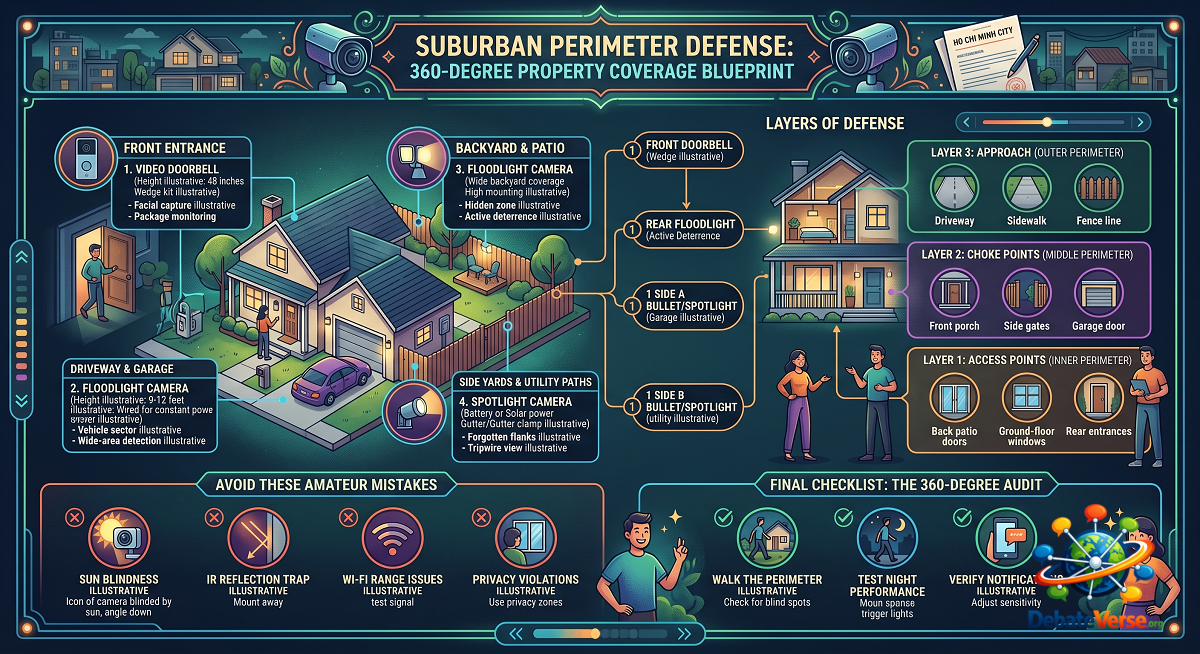
For suburban homeowners, the security goal is simple: establish a digital perimeter that detects potential intruders before they reach your front door. A single video doorbell is a good start, but it leaves 270 degrees of your property—side gates, backyards, driveways, and dark patio corners—completely unmonitored.
A truly robust "360-degree" defense network requires strategically placing complementary cameras to create overlapping fields of view, eliminating blind spots and providing early warning of any perimeter breach.
This blueprint outlines the standard 4-to-5-camera tactical layout used by security professionals to secure a typical quarter-acre suburban lot, ensuring total situational awareness.
The Core Strategy: Layers of Defense
Effective property security is built in concentric layers, moving from the street inward to the home's core.
plot
                        LAYERS OF SUBURBAN DEFENSE

  LAYER 3: THE APPROACH (Outer Perimeter)
  [ Driveway Entry ] [ Sidewalk Path ] [ Fence Line ]
  * Goal: Detect vehicles and pedestrians entering property boundaries.

  LAYER 2: THE CHOKE POINTS (Middle Perimeter)
  [ Front Porch ] [ Side Gates ] [ Garage Door ]
  * Goal: Capture high-res faces and deter entry through natural bottlenecks.

  LAYER 1: THE ACCESS POINTS (Inner Perimeter)
  [ Back Patio Doors ] [ Ground-Floor Windows ] [ Rear Entrances ]
  * Goal: Monitor vulnerable entryways hidden from street view.
The 4-Camera "Diamond" Configuration
For most single-family rectangular homes, a 4-camera "diamond" setup provides the most efficient 360-degree coverage.
1. Camera 1 (Front): Video Doorbell facing the street.
2. Camera 2 (Rear): Floodlight or Spotlight Camera covering the backyard.
3. Camera 3 (Side A): Bullet or Spotlight Camera covering the driveway/garage side.
4. Camera 4 (Side B): Bullet or Spotlight Camera covering the opposite utility/gate side.
Step-by-Step Deployment Guide
1. Front Entrance: The Primary Choke Point
Hardware Goal: High-resolution facial capture and package monitoring.
Recommended Gear: A high-definition video doorbell (2K resolution or higher) with a tall or "Head-to-Toe" field of view.
Placement Strategy: Mount at standard doorbell height (approximately 48 inches off the ground). Use an angle wedge kit if your door is recessed or adjacent to a wall, angling the lens toward the approaching walkway rather than straight across the street. This ensures you capture faces clearly rather than just side profiles.
2. The Driveway & Garage: The Vehicle Sector
Hardware Goal: License plate recognition (LPR) capability at night and wide-area motion detection.
Recommended Gear: A hardwired Floodlight Camera (e.g., Ring Floodlight Cam Pro, Eufy Floodlight Cam E340, or Arlo Pro 3 Floodlight). Hardwiring is essential here to support high-lumen active LED lights without draining batteries.
Placement Strategy: Mount above the garage door, centered, at a height of 9 to 12 feet. Aim the camera downward at a 30-to-45-degree angle. This height is crucial—it's high enough to be out of easy reach of vandals, but low enough to capture clear angles of faces and vehicle plates as they pull into the driveway.
3. The Backyard & Patio: The Hidden Zone
Hardware Goal: Wide coverage of dark, private spaces and active deterrence.
Recommended Gear: Another hardwired Floodlight Camera or a high-quality Spotlight Camera with excellent color night vision.
Placement Strategy: Mount high on the rear wall of the house (e.g., under the second-story eaves or above patio doors) to maximize the field of view across the entire lawn. The motion-activated lights serve a dual purpose: illuminating the yard for the camera and startling potential trespassers who think they are hidden in the dark.
4. Side Yards & Utility Paths: The Forgotten Flanks
Hardware Goal: Narrow, focused coverage of fence lines, gates, and utility infrastructure (HVAC units).
Recommended Gear: Battery-powered or Solar-assisted Spotlight/Bullet Cameras. Running new electrical wiring to the sides of a house is often difficult and expensive, making battery models the practical choice for these lower-traffic zones.
Placement Strategy: Mount near the front corner of the house, aiming down the narrow side path toward the back gate. This creates a "tripwire" view—anyone moving from the front yard to the back along the side of the house must pass directly through this camera's field of view.
Avoiding Common Amateur Mistakes
Even with the right hardware, poor placement can ruin a system's effectiveness. Avoid these critical errors:
The "Sun Blindness" Error: Pointing a camera directly East or West. Sunrise and sunset will blast directly into the lens, blinding the sensor and creating useless silhouetted footage for hours each day. Angle cameras down to minimize direct horizon exposure.
The Infrared Reflection Trap: Mounting a camera too close to a soffit, gutter, or adjacent wall. At night, the camera's infrared LEDs will reflect off the nearby surface, blinding the camera and leaving the rest of the scene in pitch blackness.
Ignoring Wi-Fi Range: Installing high-resolution cameras on the far corners of a large property without checking Wi-Fi signal strength. Weak Wi-Fi results in choppy video, missed alerts, and battery drain as the camera constantly struggles to reconnect. Test signal strength with your phone before permanently mounting hardware.
Overlapping Privacy Violations: Aiming side-yard cameras so they capture a neighbor's windows or private backyard patio. Use the camera app's "Privacy Zones" feature to digitally black out areas beyond your property line to respect neighbor privacy and avoid disputes.
Final Checklist: The 360-Degree Audit
Once your four cameras are mounted, perform a practical audit:
1. Walk the Perimeter: Have someone walk around the entire outside of your house, hugging the walls and fences. Watch the live feeds. Are there any points where the person completely disappears from all camera views? If so, adjust angles to close the gap.
2. Test Night Performance: Wait until dark. Walk up the driveway and to the back door. Do the motion-activated lights trigger reliably? Are faces recognizable in the night vision footage, or are they washed out by IR glare?
3. Verify Notifications: Ensure your phone receives distinct, timely alerts for a person approaching the front door versus a car entering the driveway. Adjust motion sensitivity and AI detection zones in the app to eliminate false alarms from blowing trees or street traffic.
By following this layered approach, you transform isolated smart cameras into a cohesive, proactive defensive perimeter that secures your entire suburban property, day and night.